

Instant coffee is a legitimately healthy choice for most adults when you drink it in moderation. It carries most of the same antioxidants as brewed coffee at roughly 7 calories a cup, and its acrylamide content, while higher, requires an unrealistic volume to become dangerous. One recent UK Biobank study linking it to shorter telomeres deserves a closer look, which we’ll get to below.
TL;DR:
- Instant coffee contains antioxidants similar to brewed coffee, mostly due to chlorogenic acids, and offers additional nutrients like potassium, magnesium, and vitamin B3.
- It typically has lower caffeine content than brewed coffee, with one teaspoon providing 30 to 90 milligrams, and most adults can consume up to four or five cups safely daily.
- Instant coffee can have up to twice the acrylamide levels of brewed coffee, but consumption of typical amounts remains well below harmful thresholds, and digestion reduces acrylamide bioavailability.
- The 2023 UK Biobank study linked each additional cup of instant coffee to an estimated 0.38-year decrease in telomere length, but this is an association, not conclusive proof of accelerated aging.
- For health benefits, choosing plain, single-ingredient instant coffee and moderating intake, especially late in the day, minimizes risks and maintains antioxidant and metabolic advantages.
Table of Contents
- Instant Coffee Health: Antioxidants and Nutrient Profile
- How Much Caffeine Is in Instant Coffee vs. Brewed?
- Acrylamide in Instant Coffee: How Worried Should You Be?
- What the Telomere Study Really Shows About Instant Coffee
- Does Instant Coffee Offer the Same Health Benefits as Brewed?
- Who Should Limit or Avoid Instant Coffee
- Choosing and Preparing Instant Coffee the Smart Way
- Weighing Convenience Against the Evidence
- A Lower-Jitter Way to Keep Your Coffee Ritual
- Sources
- FAQ
Instant Coffee Health: Antioxidants and Nutrient Profile
Think of antioxidants as tiny fire extinguishers patrolling your bloodstream, putting out sparks called free radicals before they damage healthy cells. Coffee, instant or brewed, is one of the biggest dietary sources of these compounds for the average adult, mostly thanks to a family of polyphenols called chlorogenic acids.
Chlorogenic acids are the workhorses here. They’re associated with reduced inflammation and better blood sugar regulation, and they survive the instant coffee manufacturing process reasonably intact. That process, called spray drying or freeze drying, brews coffee at scale, then removes the water to leave concentrated granules. It’s a rougher treatment than a slow pour over, but research keeps finding that instant coffee’s antioxidant activity holds up surprisingly close to its brewed counterpart.
Beyond chlorogenic acids, instant coffee delivers a modest supporting cast of nutrients:
- Potassium, which helps regulate fluid balance and nerve signals
- Magnesium, involved in over 300 enzymatic reactions in your body
- Niacin (vitamin B3), which supports energy metabolism
None of these show up in large enough amounts to replace a multivitamin, but they add up as part of a varied diet.
A standard cup of instant coffee contains approximately 7 calories when brewed plain with water. That makes it one of the lowest-calorie hot beverages you can reach for, right up until you start adding sugar, flavored creamer, or syrup. This is where the “instant coffee good or bad” question gets murkier. The coffee itself is lean and antioxidant-rich. The powdered mixes marketed as “instant coffee” that come preloaded with dairy powder and sugar are a different product with a different nutritional story, and it’s worth reading the label before assuming your instant coffee habit is calorie-neutral.
How Much Caffeine Is in Instant Coffee vs. Brewed?
Instant coffee generally runs lighter on caffeine than brewed. A typical cup made with one teaspoon of granules contains roughly 30 to 90 milligrams of caffeine, compared to about 70 to 140 milligrams in a cup of drip brewed coffee. That’s a meaningful gap, and it’s one reason some people switch to instant when they’re trying to cut back without giving up the ritual entirely.
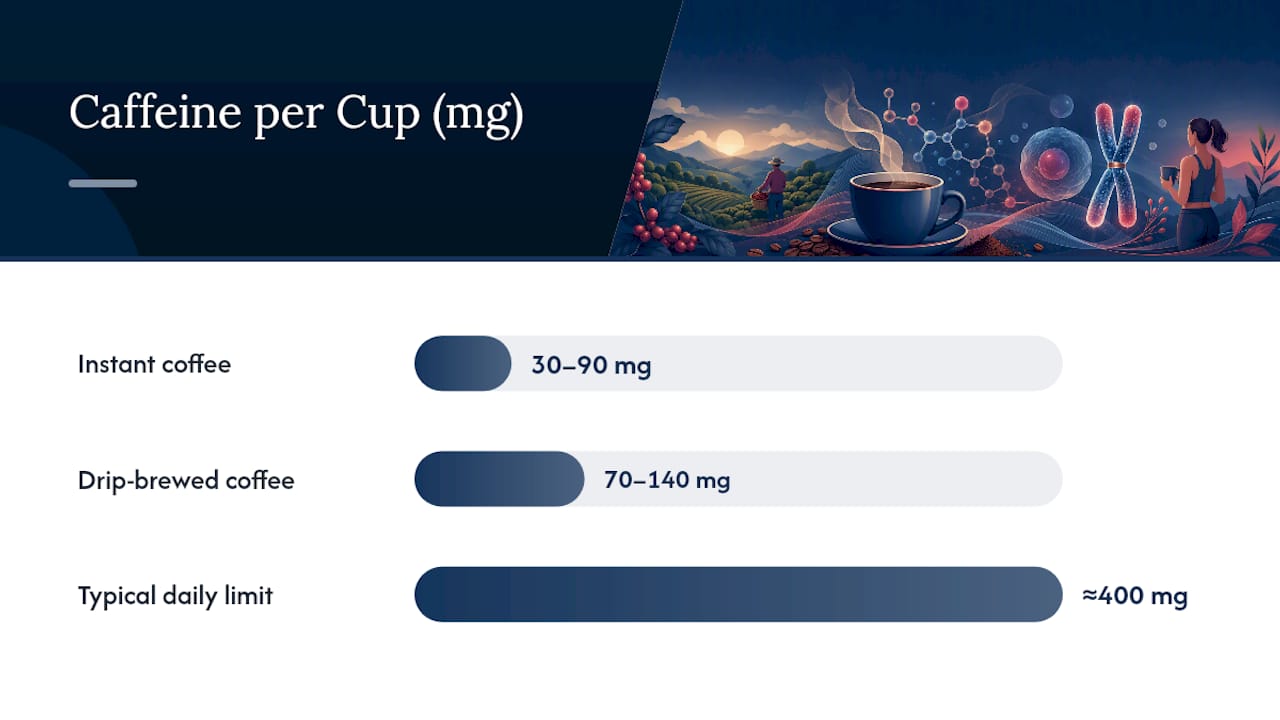
The variability comes down to bean origin, roast level, and how much powder you actually scoop. A heaping teaspoon delivers noticeably more caffeine than a level one, so if you’re tracking intake closely, a kitchen scale beats eyeballing it.
Most healthy adults tolerate up to about 400 milligrams of caffeine a day, which corresponds to around four to five cups of brewed coffee or more instant coffee before reaching that limit. Past that point, common effects include:
- Jitteriness or a racing heartbeat
- Trouble falling asleep, even hours after your last cup
- Headaches from caffeine withdrawal on days you skip it
- Digestive upset or acid reflux
If you want to dial back your intake without abandoning the habit, a few tweaks help. Switch your afternoon cup to a decaf instant blend, measure your powder instead of free pouring, and shift your last cup earlier in the day so it clears your system before bedtime. For a deeper breakdown of low-caffeine options, Emberk’s guide to low caffeine coffee walks through varieties worth trying.
Pro Tip: Caffeine has a half-life of about five to six hours in most adults, so a 3 p.m. cup can still be about half in your system at 9 p.m. If sleep quality has been slipping, that’s the first variable to test.
If you notice heart palpitations, chest tightness, or unusual anxiety after coffee, that’s worth a conversation with a doctor rather than something to push through.
Acrylamide in Instant Coffee: How Worried Should You Be?
Acrylamide is a chemical compound that forms naturally when starchy or plant-based foods are roasted or heated at high temperatures, coffee beans included. It’s classified by the International Agency for Research on Cancer as a probable human carcinogen based on animal studies at doses far beyond typical dietary exposure, a classification that has sparked understandable concern around any roasted food, coffee included.
Here’s the part specific to instant coffee: the drying process, whether spray dried or freeze dried, concentrates certain compounds, and instant coffee can contain up to twice the acrylamide levels found in regular brewed coffee, according to McGill University’s Office for Science and Society. That sounds alarming until you run the actual numbers.
Toxicology has a foundational principle worth remembering here: the dose makes the poison. Water is essential to life and lethal in large enough quantities. The same logic applies to acrylamide.
- Conservative advisory thresholds for acrylamide exposure are set well below any dose shown to cause harm in animal studies, building in a wide safety margin.
- Reaching even the lower bound of those conservative thresholds through instant coffee alone would require drinking an extremely large volume, multiple liters, more than 10 cups in a single day, consumed consistently.
- Typical consumption, one to three cups a day, sits nowhere near that threshold, even accounting for other dietary sources of acrylamide like potato chips or toast.
There’s a further wrinkle that makes the real-world risk even smaller than lab measurements suggest. Digestion isn’t a perfectly efficient delivery system. Research modeling gastrointestinal digestion found that acrylamide’s bioaccessibility, the amount that actually makes it from your gut into your bloodstream, drops by up to 27% during digestion. That means chemical assays measuring acrylamide in the dry powder are likely overstating what your body ever absorbs.
Health Canada monitors acrylamide levels in food as part of its ongoing food safety surveillance, and neither Health Canada nor the IARC have issued specific consumption limits for instant coffee. The practical takeaway: acrylamide is a real compound worth understanding, not a reason to swap out your morning routine.
What the Telomere Study Really Shows About Instant Coffee
A 2023 analysis of nearly 469,000 participants in the UK Biobank found something that made headlines: each additional cup of instant coffee was associated with an approximate 0.38-year decrease in telomere length, a marker sometimes used as a proxy for cellular aging.
Telomeres are the protective caps at the ends of your chromosomes, similar to the plastic tips on shoelaces that keep them from fraying. They shorten naturally as cells divide over a lifetime, and shorter telomeres have been loosely associated with aging and certain disease risks in population research.
What makes this study notable is its method. The researchers didn’t just observe a correlation; they also ran a Mendelian randomization analysis, a genetic technique that uses naturally occurring DNA variations to test whether an association is more likely to reflect cause and effect rather than coincidence or confounding. The MR results supported a possible causal link, which is a stronger signal than a typical observational finding.
A 0.38-year telomere decrease per additional daily cup sounds precise, but researchers are careful to frame it as an association strengthened by genetic analysis, not proof that instant coffee accelerates aging in any individual drinker.
Even strong observational data has real limits worth naming honestly:
- Diet, smoking, exercise, and stress can all confound telomere measurements, and no observational study fully accounts for every variable.
- Telomere length varies by cell type and measurement method, adding noise to any single reading.
- The clinical meaning of a 0.38-year shift is not established. It’s a biomarker association, not a documented change in disease outcomes or lifespan.
If you’re weighing this study against everything else in this article, the honest read is that it’s a signal worth watching, not a verdict. Coffee research evolves constantly, and one study, however well designed, rarely overturns decades of broader population data.
Does Instant Coffee Offer the Same Health Benefits as Brewed?
Coffee is a genuinely complex beverage, made up of more than 800 different compounds, and researchers have spent decades trying to untangle which ones drive its health associations. The encouraging news for instant coffee drinkers: most large population studies don’t distinguish sharply between instant and brewed when it comes to major outcomes.
Regular coffee consumption, instant included, has been linked in population research to lower risk of type 2 diabetes, better liver enzyme markers, and a 10 to 20% reduction in all-cause mortality in some Mayo Clinic Press analyses of moderate drinkers. Experts at Tufts University’s Health & Nutrition Letter point out that the modest compositional differences between instant and brewed don’t appear to erase these associations, meaning your choice can reasonably come down to convenience and taste.
The plausible mechanisms behind these benefits include:
- Chlorogenic acids and other polyphenols reducing oxidative stress
- Caffeine’s role in improving insulin sensitivity and metabolic markers over time
- Coffee’s diterpene compounds, cafestol and kahweol, which raise LDL cholesterol in unfiltered brews, but these show up in negligible amounts in instant coffee due to how it’s processed, so cholesterol concerns tied to those compounds largely don’t apply here
A few caveats matter before you take this as blanket permission. Much of the epidemiological data linking coffee to reduced disease risk comes from populations drinking three to five cups a day, plain, without heavy sweeteners or creamers. Pre-sweetened instant mixes change that equation considerably, adding sugar and sometimes hydrogenated oils that work against the very benefits researchers are measuring. Confounding is also a persistent issue: people who drink moderate coffee often share other habits, like regular meal timing or lower smoking rates, that independently affect health outcomes.
The practical guidance holds up: moderate, plain instant coffee fits comfortably within a health-conscious diet.
Who Should Limit or Avoid Instant Coffee
Instant coffee isn’t right for everyone in the same amounts, and a few groups genuinely benefit from tighter caps or a different approach entirely.
- Pregnant people should generally keep caffeine intake under 200 milligrams a day, a limit many health authorities recommend, which means watching cup count and choosing lower-caffeine instant varieties or decaf options.
- Children and teenagers metabolize caffeine differently than adults and generally shouldn’t consume it in coffee-level amounts at all.
- Caffeine-sensitive individuals, including people prone to anxiety or panic symptoms, often notice a much lower threshold before jitteriness or racing thoughts set in.
- People with certain heart conditions, particularly arrhythmias, should talk to a cardiologist before making caffeine a daily habit.
- Anyone on interacting medications, including some antidepressants and stimulant prescriptions, should check with a pharmacist since caffeine can amplify or interfere with certain drugs.
If any of these apply to you, decaf instant coffee or a lower-caffeine functional blend lets you keep the ritual without the risk. When in doubt, a quick conversation with your doctor or pharmacist beats guessing.
Choosing and Preparing Instant Coffee the Smart Way
Getting the benefits without the baggage mostly comes down to what’s in the jar and what you do with it before it hits your cup.
Start with the label. Look for plain, single-ingredient instant coffee, just dried coffee, nothing else. Skip anything listing sugar, hydrogenated oils, or artificial creamer near the top of the ingredient list, since those additions undercut the low-calorie, antioxidant-rich profile that makes plain instant coffee a reasonable choice in the first place. Organic options reduce your exposure to pesticide residue, though this matters more to some drinkers than others.
- Choose plain instant granules over flavored powdered mixes
- Check for organic or single-origin sourcing if that matters to you
- Brew with hot, not boiling, water to preserve delicate antioxidant compounds
- Shift your last cup to early afternoon if sleep has been an issue
Timing matters almost as much as the product itself. Caffeine’s long half-life means a cup at 4 p.m. can still be affecting you at bedtime. Keeping your coffee window to morning and early afternoon gives your body a clear runway to wind down.
If you’re drawn to functional blends that add mushrooms like lion’s mane or reishi, scrutinize the claims the same way you would any supplement. Legitimate products use fruiting body extracts with documented ratios of active compounds, not just mushroom flavoring. Emberk’s guide to reishi in coffee covers what to look for and how these additions actually function.
Pro Tip: A simple daily plan that works for most people: one cup of plain instant coffee in the morning, a second lower-caffeine cup by early afternoon if needed, and nothing caffeinated after 2 p.m.
Weighing Convenience Against the Evidence
Coffee research rarely delivers a clean verdict, and instant coffee is no exception. What strikes me most about the current evidence is how much of the conversation gets flattened into “good” or “bad” when the honest picture is more textured: real antioxidant benefits, a caffeine profile that’s often gentler than people assume, an acrylamide risk that’s real on paper but negligible in practice, and one genetics-informed study on telomeres that raises a legitimate question without settling it.
The instant coffee vs brewed debate matters less than what you put in the cup and how much of it you drink. A plain, moderate habit built around quality ingredients beats obsessing over which format delivers marginally more antioxidant activity. If jitters, crashes, or anxiety are part of your coffee relationship, that’s a signal worth listening to, and it’s exactly the gap products like Emberk’s mushroom coffee were built to address.
— Tatiana
A Lower-Jitter Way to Keep Your Coffee Ritual
If the caffeine swings and afternoon crashes are the part of your coffee habit you’d change, some coffee blends infuse organic instant coffee with six functional mushrooms, including lion’s mane, chaga, reishi, turkey tail, maitake, and cordyceps, sourced sustainably and lab-tested with no fillers, aiming for the calm alertness of caffeine without the crash that follows it.
This makes it a natural fit if you’re the kind of drinker who loves the ritual of coffee but wants steadier energy through a workday, or if the caffeine-sensitivity concerns covered above hit close to home. The mushroom coffee blend is a straightforward swap for your usual jar, and if you’d rather ease in with something creamier, the mushroom latte offers the same functional mushroom lineup in a softer format. Order a bag and see how your afternoons feel by the end of the week.
This article is general information, not a substitute for advice from a qualified doctor. Consult a qualified healthcare professional about your own circumstances before acting on anything here.
Sources
- Instant Coffee: Good or Bad? — Healthline
- Instant Coffee and Acrylamide: Should You Be Worried? — McGill OSS
- Instant Coffee Is Negatively Associated with Telomere Length — PMC (2023)
- Q. Can you tell me if instant coffee confers the same health benefits as brewed coffee? — Tufts HNRCA
FAQ
Are there any health concerns with instant coffee?
The main concerns are elevated acrylamide content compared to brewed coffee and a small observational link to shorter telomeres, though both require context: acrylamide exposure from typical drinking habits stays far below risky thresholds.
Is instant coffee safe to drink every day?
Yes, for most healthy adults, one to three cups of plain instant coffee daily fits within safe caffeine limits and delivers antioxidant benefits comparable to brewed coffee.
Which brand of instant coffee is the healthiest?
No single brand is definitively “healthiest,” but plain, single-ingredient instant coffee without added sugar or creamer is the better choice nutritionally; functional blends like Emberk’s mushroom coffee add lower caffeine and reduced jitters for drinkers who want steadier energy.
Is instant coffee healthier than brewed coffee?
Neither is clearly healthier. Instant coffee has slightly less caffeine and up to twice the acrylamide, but population studies find comparable health associations for both, so the choice mostly comes down to convenience and personal tolerance.
0 comments