

Instant coffee is dehydrated brewed coffee that prioritizes speed and shelf life; brewed coffee is freshly extracted from grounds and prioritizes flavor complexity. If you want the richest, most aromatic cup possible, brewed wins. If you need something ready in 30 seconds with no equipment, instant is the smarter call. That said, premium freeze-dried instant has genuinely narrowed the gap, and the choice is less obvious than it used to be.
Pick instant when you want:
- Speed and portability (ready in under a minute, no grinder or brewer needed)
- Long shelf life for travel, camping, or emergency backup
Pick brewed when you want:
- Full flavor complexity, layered aroma, and a ritual worth savoring
- Control over every variable from grind size to water temperature
One caveat worth keeping in mind: a high-quality freeze-dried Arabica instant can surprise even skeptical coffee drinkers, especially in a blind taste test.
Key Takeaways
Brewed coffee delivers more flavor complexity and higher caffeine than instant, but premium freeze-dried Arabica instant has narrowed the gap enough that the right choice depends almost entirely on your lifestyle priorities.
| Point | Details |
|---|---|
| Flavor still favors brewed | Fresh extraction preserves hundreds of volatile aromatics that dehydration partially removes. |
| Caffeine gap is real | Instant runs 60–80 mg per 8 oz; brewed drip typically delivers 95–165 mg per 8 oz. |
| Freeze-drying changes the equation | Premium freeze-dried Arabica instant outperforms commodity spray-dried products significantly. |
| Instant wins on convenience | No equipment, 30–60 seconds to prepare, and a shelf life of 1–2 years sealed. |
| Emberk adds functional benefits | Emberk’s instant mushroom coffee pairs moderate caffeine with six functional mushrooms for steady, clear energy. |
Table of Contents
- How instant coffee is actually made
- What brewed coffee is and why the method matters
- Instant coffee vs brewed: a side-by-side comparison
- How to make each type taste its best
- Caffeine in instant vs brewed: what the numbers actually mean
- Health, additives, and what to watch on the label
- What taste tests and coffee experts say about instant vs brewed
- How to choose between instant and brewed for your lifestyle
- Why keeping both instant and brewed at home makes sense
- Emberk instant mushroom coffee: a functional take on instant
- Sources
- FAQ
How instant coffee is actually made
Instant coffee starts as real brewed coffee. Manufacturers brew a concentrated liquid from roasted grounds, then remove almost all the water to leave behind soluble granules or powder. Add hot water later, and you’re essentially reconstituting that original brew.
Two methods handle the drying step, and they produce noticeably different results:
- Freeze-drying: The brewed concentrate is frozen into a solid, then placed in a vacuum chamber where ice sublimates directly into vapor. This slower, costlier process preserves more volatile flavor compounds than heat-based methods, which is why most premium instant brands use it.
- Spray-drying: Hot air blasts the liquid concentrate into a fine mist, evaporating water almost instantly. It’s cheaper and faster, but the heat degrades delicate aromatic compounds, leaving a flatter, sometimes slightly bitter result.
Most commodity instant products use spray-drying with Robusta beans, which are higher in caffeine but earthier and harsher in flavor. Premium lines lean on 100% Arabica and freeze-drying, and taste tests confirm the difference is real.
On the shelf, unopened instant holds up well: sealed containers can stay fresh for 1–2 years when stored cool and dry. Once opened, keep it airtight and away from moisture. Some brands add emulsifiers, dried milk solids, or artificial flavorings to their instant blends, so scanning the ingredient list before buying is worth the ten seconds it takes.
If you see “coffee whitener,” “creamer,” or “natural flavors” listed, those are additives, not coffee.*
What brewed coffee is and why the method matters
Brewed coffee is what happens when hot water passes through or steeps with ground roasted beans, pulling out soluble compounds in real time. That live extraction is what gives brewed coffee its depth. Hundreds of volatile aromatic compounds are released during brewing and largely account for its richer aroma and complexity compared to any dehydrated product.
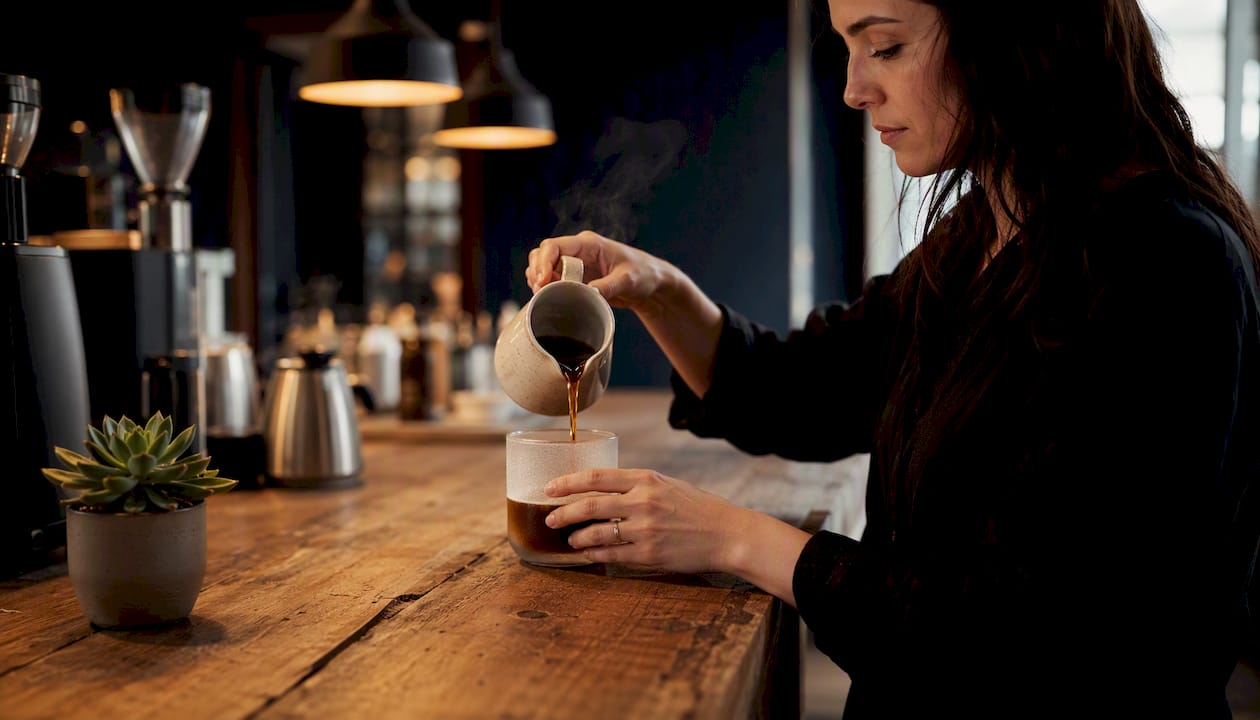
Four variables shape every cup: grind size, water temperature, contact time, and brew method. Coarser grinds and shorter contact times (like cold brew or French press) produce a smoother, lower-acid cup. Finer grinds and higher pressure (espresso) concentrate flavor and oils into a small, intense shot. Understanding Arabica vs Robusta flavor profiles also helps here, since the bean species you start with sets the flavor ceiling for any method.
Common home methods and what they emphasize:
- Drip (auto-drip): Consistent, approachable, mild body. Brew time roughly 5–8 minutes.
- Pour-over (Chemex, V60): Clean, bright, nuanced. Brew time 3–4 minutes with a 30-second bloom.
- French press: Full-bodied, oily, rich. Steep 4 minutes.
- Moka pot: Concentrated, espresso-adjacent. 5–7 minutes on the stovetop.
- Espresso machine: Intense, syrupy, fast. 25–30 seconds of extraction.
Ground coffee’s freshness window is short. Pre-ground beans start losing volatile aromatics within days of opening; whole beans stay fresher for two to three weeks after roasting if stored in an airtight container away from light and heat.
Instant coffee vs brewed: a side-by-side comparison
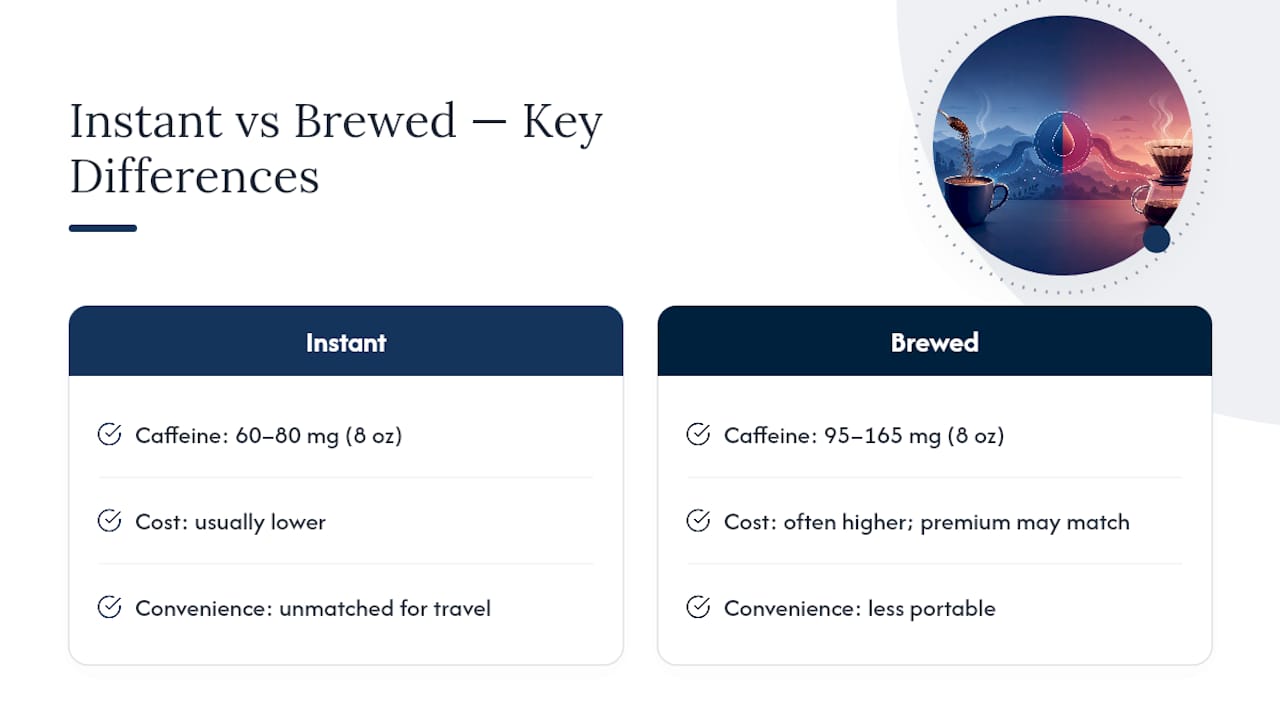
The practical differences between instant and brewed come down to a handful of dimensions. Here’s how they stack up across the factors most readers actually care about.
A few rows deserve extra attention. Caffeine is the most misunderstood variable: instant typically delivers 60–80 mg per 8 oz while brewed drip runs 95–165 mg, meaning a single brewed cup can contain more than twice the caffeine of an instant serving. Cost per cup favors instant at the low end, but premium freeze-dried Arabica products can close that gap. Convenience is instant’s clearest advantage, and for travel or camping, it’s essentially unmatched.
How to make each type taste its best
Getting the most out of either format comes down to a few small choices that most people skip.
For instant coffee
- Use the right ratio. Start with 1 rounded teaspoon (about 2 grams) per 8 fl oz of water and adjust from there. More powder makes a stronger cup; less makes it thinner, not smoother.
- Mind your water temperature. Water between 175°F and 185°F (just off a full boil) dissolves instant cleanly without scorching the granules. Boiling water can add bitterness.
- Dissolve in a small amount first. Add 1–2 tablespoons of cold or room-temperature water to the powder and stir into a paste before adding hot water. This “blooming” step produces a noticeably smoother result.
- For iced instant: Dissolve the powder in 2 oz of hot water, then pour over ice. Check out this mushroom iced coffee recipe for a creative cold-brew-style variation using instant.
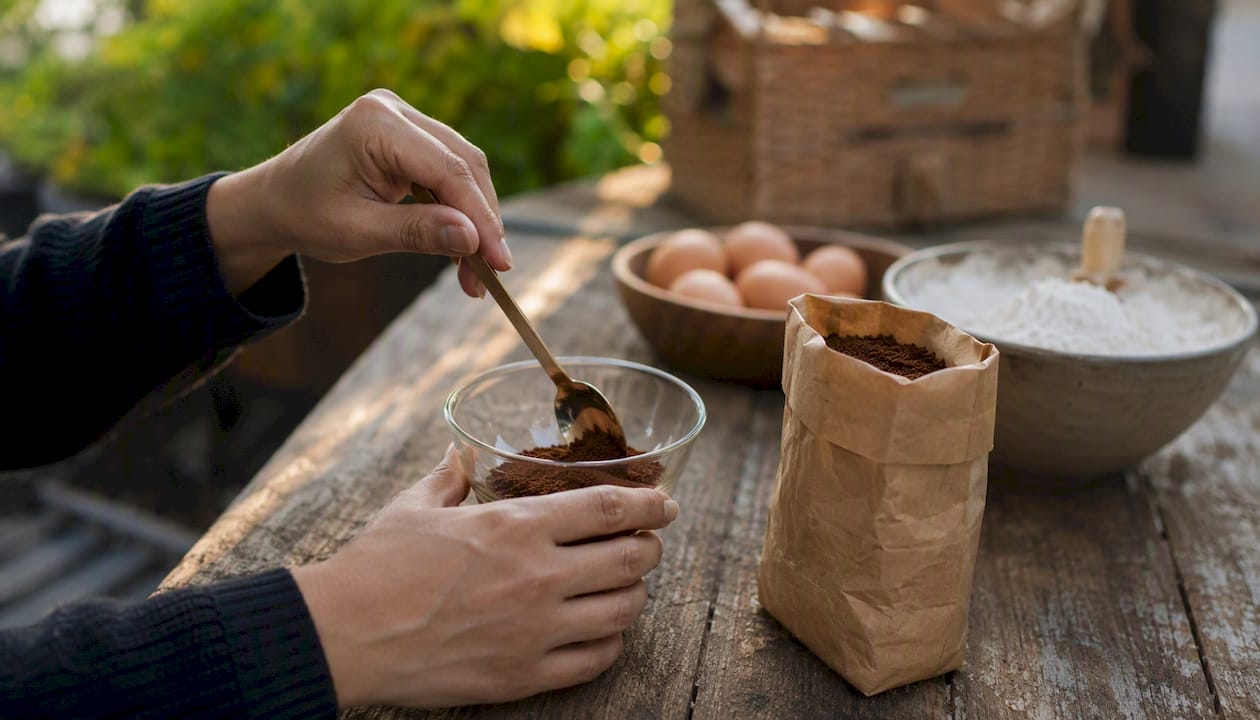
- For cooking: Instant dissolves cleanly without adding extra liquid, making it ideal for brownies, tiramisu, or coffee rubs. Recipe guides recommend it specifically for baked goods where brewed coffee would alter texture.
Pro Tip: If your instant cup tastes flat, try a pinch of salt. It sounds odd, but a tiny amount suppresses bitterness and opens up the flavor without making the coffee taste salty.
For brewed coffee
- Dose accurately. A standard starting ratio is 1:15 to 1:17 coffee to water by weight (roughly 2 tablespoons per 6 oz of water for drip).
- Match grind to method. Coarse for French press and cold brew, medium for drip, medium-fine for pour-over, fine for espresso.
- Water temperature matters. Target 195°F–205°F for most methods. Too cool and you under-extract (sour, thin); too hot and you over-extract (bitter, harsh).
- Bloom your pour-over. Pour twice the weight of water as coffee grounds, wait 30 seconds, then continue. This releases CO₂ and produces a more even extraction.
- Store beans properly. An airtight container at room temperature, away from light, keeps whole beans fresh for up to three weeks post-roast.
Caffeine in instant vs brewed: what the numbers actually mean
Caffeine is where the two formats diverge most sharply. Instant coffee typically delivers around 60–80 mg per 8 fl oz, while brewed drip runs roughly 95–165 mg per 8 fl oz. That’s a meaningful difference if you’re sensitive to stimulants or trying to manage your intake across the day.
Several factors drive the variance within each category:
- Bean species: Robusta contains roughly twice the caffeine of Arabica by weight. Commodity instant blends heavy in Robusta can punch above the typical instant range; premium Arabica instant tends to sit at the lower end.
- Roast level: Lighter roasts retain slightly more caffeine than dark roasts, though the difference is smaller than most people assume.
- Brew concentration: A longer steep time or finer grind extracts more caffeine from the same amount of grounds.
- Serving size: An 8 oz cup is the standard reference, but many home brewers pour 12–16 oz, which changes the total caffeine significantly.
| Coffee Type | Caffeine per 8 fl oz | Key Driver |
|---|---|---|
| Instant (commodity) | 60–80 mg | Robusta blend, spray-dried |
| Instant (premium Arabica) | 60–80 mg | Arabica, lower caffeine species |
| Drip brewed | 95–165 mg | Grind, contact time, dose |
| Espresso (per 1 oz shot) | 60–80 mg | High pressure, fine grind |
Caffeine note: Instant coffee’s lower caffeine per serving makes it a practical choice for an afternoon cup when you want alertness without disrupting sleep. If you want more stimulant effect from instant, use 1.5 teaspoons per 8 oz rather than switching formats entirely.
If you want more caffeine from brewed coffee, a stronger dose or a Robusta-forward blend will get you there faster than switching to a different brew method. If you want less, instant or a light-roast Arabica instant is a reasonable starting point.
Health, additives, and what to watch on the label
Both instant and brewed coffee deliver antioxidants, but the amounts differ. Brewed coffee generally has higher chlorogenic acid content than instant, the primary antioxidant class in coffee. Think of chlorogenic acids as the compounds that help neutralize oxidative stress in the body. The dehydration process used to make instant degrades some of these compounds, so you’re getting a bit less per cup, though both formats still contribute meaningfully to daily antioxidant intake.
Acrylamide is a compound that forms when starchy foods or coffee beans are roasted at high temperatures. Instant coffee can have slightly higher acrylamide levels than some brewed options, but per-cup exposure across both formats is generally considered low by health authorities. It’s worth knowing about, not worrying about.
A few things to watch on instant coffee labels:
- Emulsifiers (like soy lecithin): used to help the powder dissolve, generally harmless but worth noting if you have soy sensitivities
- Dried milk solids or creamers: common in “3-in-1” style packets; avoid these if you’re dairy-free or watching added sugars
- “Natural flavors”: a catch-all term that can mean almost anything; cleaner products list only coffee as the ingredient
Pro Tip: The shortest ingredient list is usually the best one. If the list runs longer than that, you’re buying a coffee-flavored product, not just coffee.
For readers who are monitoring oxalate intake or caffeine sensitivity, instant’s lower caffeine per serving and simpler ingredient profile can actually be an advantage, provided you choose a clean, additive-free product.
What taste tests and coffee experts say about instant vs brewed
The conventional wisdom that instant is always inferior has taken some real hits recently. A 2025 Guardian blind taste test found that 77% of tasters preferred a high-quality instant coffee over the drip options tested in that experiment. That’s a striking result, and it challenges a lot of assumptions.
The methodology caveat matters here: blind taste tests compare specific products under specific conditions, and the drip coffees in the Guardian test may not have been optimally prepared. Still, the finding aligns with what Food & Wine’s taste test showed: freeze-dried, 100% Arabica instant coffees scored well on balance and drinkability, outperforming commodity instant options by a wide margin.
Where brewed still wins, clearly and consistently, is aroma. Fresh extraction releases hundreds of volatile aromatic compounds that largely dissipate during the dehydration process. You can taste the difference in a blind test, but you can smell it from across the room. For coffee drinkers who love the ritual of a morning brew, that aromatic dimension is part of the experience, not just a bonus.
The takeaway: if you’ve written off instant based on a jar of commodity spray-dried granules, a premium freeze-dried Arabica product is worth trying. The category has genuinely improved.
How to choose between instant and brewed for your lifestyle
The right choice depends less on which format is “better” and more on what you actually need on a given morning. Work through these questions:
- Is flavor your top priority? Brewed coffee, especially pour-over or French press, gives you the most aromatic, complex cup. Instant is a reasonable second if you choose freeze-dried Arabica.
- Do you have 5–10 minutes and equipment? If yes, brewed is worth the effort. If you’re rushing or traveling, instant removes every barrier.
- How often do you drink coffee? Daily drinkers who care about flavor usually invest in a brewer. Occasional drinkers or those who want a backup option often find instant more practical.
- Are you traveling or camping? Instant wins here without contest. Single-serve packets weigh almost nothing and need only hot water.
- What’s your budget per cup? Commodity instant is the cheapest option. Premium instant and home-brewed drip are comparable. Specialty café-quality brewing at home costs more upfront in equipment.
- Do you care about packaging waste? Loose-ground coffee with a reusable filter is the lowest-waste option. Single-serve pods are the highest. Instant packets fall in the middle.
Scenario quick-read:
- Commuter: Instant packets in a travel mug, no question.
- Home coffee hobbyist: Pour-over or French press with freshly ground beans.
- Office worker with no equipment: Instant or a quality cold-brew concentrate.
- Camper or backpacker: Instant, ideally in single-serve packets.
- Baker or cook: Instant for recipes; brewed for drinking.
That’s the detail that separates genuinely functional mushroom coffee from marketing-forward blends. Emberk’s mushroom coffee purchase guide walks through exactly what to check.*
Why keeping both instant and brewed at home makes sense
Here’s an honest take: the instant-versus-brewed debate is a false binary for most people. The two formats solve different problems, and treating them as rivals misses the point.
My own preference leans toward brewed for the morning ritual. There’s something about the pour-over process, the bloom, the smell filling the kitchen, that no instant product fully replicates. But I keep instant on hand without apology. It’s there for late-afternoon cups when I don’t want to run another full brew, for travel when packing a grinder isn’t realistic, and for baking when a recipe calls for dissolved coffee and I don’t want to brew a whole pot.
The more interesting shift is in how good premium instant has become. If you last tried instant coffee from a grocery-store jar a decade ago, the current generation of freeze-dried Arabica products is a different experience. Trying one with an open mind is worth it, especially if convenience is a real constraint in your life.
Quality varies widely in both categories. A mediocre drip brewer with stale pre-ground beans will lose to a well-made premium instant. The format matters less than the inputs and the care you put into preparation.
Emberk instant mushroom coffee: a functional take on instant
If you’ve decided that instant fits your lifestyle and you want it to do more than just caffeinate you, Emberk’s instant mushroom coffee is worth a close look. It’s lab-tested, dairy-free, and contains no added sugars or artificial ingredients.
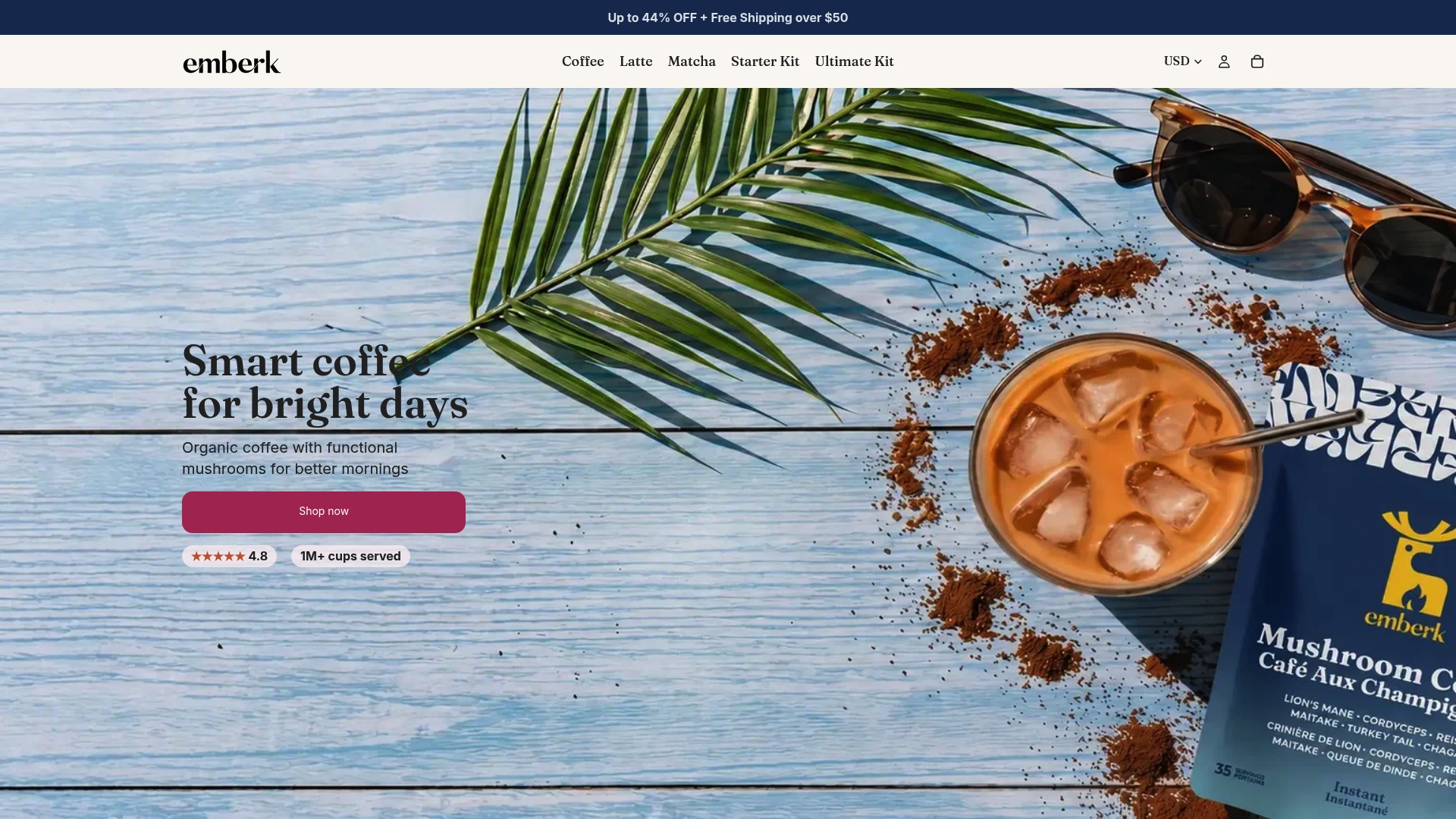
The caffeine level is intentionally moderate, which makes it a practical afternoon option when you want mental clarity without the jitters or the sleep disruption that a full brewed cup can bring later in the day. Lion’s Mane supports cognitive focus; adaptogens like Reishi help manage stress responses. You can read more about the benefits of functional mushrooms if you’re curious about the science behind the blend. For anyone who’s been looking for an instant that goes beyond convenience, Emberk’s mushroom coffee is a genuinely different kind of cup. Browse the full range at Emberk’s mushroom coffee collection and find the format that fits your routine.
Sources
These are the primary sources cited throughout this article, each offering a different angle on the instant-versus-brewed question.
- Is Instant Coffee Actually Worth Drinking Now? — Martha Stewart
- Ground Coffee vs Instant Coffee: What Are The Main Differences? — Breville
- The Best Instant Coffee, According to Our Taste Test — Food & Wine
- Instant Coffee vs Fresh Brewed: Is the Difference Worth It? — HisWordCoffee
- Is Instant Coffee Bad for You? Here’s What to Know — GoodRx
FAQ
Is instant coffee as good as brewed for flavor?
Premium freeze-dried Arabica instant can come close, but brewed coffee retains more volatile aromatic compounds and generally delivers greater complexity.
Is instant coffee real coffee?
Yes. Instant coffee is made from real brewed coffee that has been dehydrated into soluble granules or powder.
Which is healthier, instant or brewed?
Both provide antioxidants, but brewed coffee typically has higher chlorogenic acid content. Instant can have slightly more acrylamide due to processing, though per-cup exposure across both formats is generally considered low. The healthiest choice depends more on what additives (if any) your instant product contains.
Why do some people avoid instant coffee?
The most common reasons are lower flavor complexity, simpler aroma, and concerns about additives in commodity blends. Commodity instant made from Robusta and spray-dried can taste flat or harsh compared to a well-brewed cup. Premium freeze-dried Arabica instant addresses most of these concerns.
What is the healthiest instant coffee to drink?
Functional options like Emberk’s instant mushroom coffee add lab-tested adaptogens without fillers, which makes them a strong choice for health-conscious drinkers.
0 comments