

Lion’s mane matcha is a functional drink blend that pairs whole-leaf matcha with lion’s mane mushroom extract or powder, giving you two timelines of benefit at once: the calm, jitter-free alertness matcha delivers within thirty minutes, and the potential cognitive support lion’s mane builds with daily use over weeks. You can make it yourself with matcha powder and a lion’s mane extract, or buy a ready-mixed version. Either way, the appeal is the same: one drink, two kinds of mental clarity.
TL;DR:
- Most lion’s mane supplements used in beverages deliver 1,000 to 1,500 mg per serving, while caffeine content from matcha ranges between 20 and 70 mg.
- Products with clearly disclosed milligram amounts and fruiting-body sourcing are more likely to contain effective doses of active compounds.
- People on blood-thinning medication, with autoimmune conditions, or who are pregnant should consult a healthcare professional before regular consumption.
- Consistent daily use over weeks is necessary to experience lion’s mane’s long-term cognitive support benefits, with immediate effects primarily from matcha’s caffeine.
- Single-serve blends with transparent labeling offer a convenient way to incorporate lion’s mane matcha into daily routines without measuring or dosing uncertainties.
Table of Contents
- What Is Lion’s Mane Matcha, Exactly?
- How Does Lion’s Mane Matcha Actually Work?
- How Much Lion’s Mane and Matcha Is Safe to Take?
- How Do You Make a Lion’s Mane Matcha Latte?
- What Should You Look for in a Ready-to-Mix Blend?
- Why Emberk’s Approach to This Category Holds Up
- How Should You Store Lion’s Mane Matcha to Keep It Fresh?
- Are There Side Effects or Allergy Risks to Know About?
- Is Lion’s Mane Matcha Better Than Taking Either One Alone?
- The Editorial Take: What Actually Matters Here
- Ready to Skip the Guesswork? Try a Ready-Mixed Blend
- Sources
- FAQ
What Is Lion’s Mane Matcha, Exactly?
Matcha is stone-ground whole tea leaf, not steeped-and-discarded tea, which is why it delivers more caffeine and a fuller nutrient profile than a standard green tea bag. Lion’s mane is a shaggy, white, brain-shaped mushroom (Hericium erinaceus) that has been used in East Asian cooking and traditional wellness practices for centuries. Blend them, and you get a drink built to bridge two different jobs: matcha’s quick lift, lion’s mane’s slower payoff.
The ingredient form matters more than most labels let on. Lion’s mane shows up as fruiting body (the mushroom cap itself, generally considered the more potent and cleaner source of active compounds), or mycelium (the root-like structure, which is cheaper to grow but often diluted with the grain it’s cultivated on). Extracts concentrate specific compounds; raw powder gives you the whole mushroom but at lower potency per gram.
You’ll typically find lion’s mane matcha in a few formats:
- Single-serve packets designed for travel or a quick morning routine
- Bulk blended powders you scoop and measure yourself
- Hybrid products that fold lion’s mane and other mushrooms into a matcha or coffee base for a broader functional profile
How Does Lion’s Mane Matcha Actually Work?
Think of your brain as a city that runs on two different kinds of maintenance crews. Matcha’s crew shows up immediately: caffeine flips on alertness, while L-theanine, an amino acid unique to tea leaves, smooths out the ride so you get focus without the jittery edge. Research on L-theanine shows this pairing produces calmer, steadier attention than caffeine alone, which is the whole reason matcha feels different from a drip coffee jolt.
Lion’s mane’s crew works on a longer contract. Compounds called hericenones and erinacines are linked to nerve growth factor (NGF) pathways, NGF being something like the crew that builds and repairs the roads your neurons travel on. Clinical research associates this mechanism with potential cognitive benefits, but the effect builds over weeks of consistent daily use, not one cup.
Matcha plus lion’s mane targets two timeframes at once: instant calm focus from the tea, and possible long-term neural support from the mushroom. That’s why it works better as a daily ritual than a one-off boost.
A typical serving delivers about 30 to 70 mg of caffeine from matcha, alongside 1,000 to 1,500 mg of lion’s mane. Drink it once and you’ll feel the matcha. Drink it daily for a few weeks and you’re giving the lion’s mane a real chance to do its slower work.
How Much Lion’s Mane and Matcha Is Safe to Take?
Commercial blends and clinical trials don’t always speak the same dosing language, and that gap trips people up more than anything else about this category. Most trials on lion’s mane use doses in the range of 1,000 mg or more daily, sometimes higher, taken consistently. Many beverage blends land in that same 1,000 to 1,500 mg neighborhood per serving, though some products disclose far less, which is why reading the label matters.
Matcha’s caffeine content runs lower than coffee. Expect somewhere around 20 to 70 mg per serving, depending on how much powder is used, well under a typical 95 mg cup of drip coffee.
A few safety notes worth taking seriously:
- Anyone on blood-thinning medication should talk to a doctor before adding lion’s mane, since some research points to mild effects on platelet function.
- People with autoimmune conditions should check with a health professional, as mushroom-derived compounds can influence immune activity.
- Pregnant or breastfeeding people should get medical guidance first, since safety data in these groups is limited.
In Canada, lion’s mane products fall under Health Canada’s natural health product and food regulations, meaning legality mainly comes down to labeling accuracy, safety data, and the specific claims a brand makes. Look for a product license number or clear ingredient disclosure on the package before you buy. Our guide on lion’s mane and coffee breaks down how this plays out in practice.
Pro Tip: If a product doesn’t list milligrams per serving anywhere on the box or website, treat that as a red flag, not a minor omission. Transparent dosing is one of the clearest signs a brand actually knows what it’s selling.
How Do You Make a Lion’s Mane Matcha Latte?
This recipe scales up or down easily, and it takes about five minutes once you’ve got the ingredients on hand.
- Sift 1 teaspoon of ceremonial or culinary-grade matcha powder into a bowl to break up clumps.
- Add 1,000 to 1,500 mg of lion’s mane extract powder (check your product’s own serving guidance).
- Pour in 2 to 3 ounces of hot water, just under boiling, around 175°F, and whisk briskly in a “W” motion with a bamboo whisk or milk frother until frothy.
- Warm 8 ounces of your milk of choice, oat and coconut both work well, and pour over the matcha mixture.
- Sweeten if you like, then serve immediately.
A few variations worth trying: for an iced version, whisk the matcha and lion’s mane with a splash of cold water, then pour over ice and top with cold milk. For a smoothie, blend the same amounts with a frozen banana, spinach, and plant milk for a heavier, meal-like drink. If you’re sensitive to caffeine, use a lower-caffeine matcha grade or cut the matcha amount by half while keeping the lion’s mane dose steady.
Ingredient grade matters most where potency counts. A cheap, low-grade matcha will taste bitter and grassy no matter how you prepare it, and a mycelium-based lion’s mane powder will underdeliver compared to a fruiting-body extract, even at the same gram weight. For more on dosing strategy, see our breakdown of nootropic matcha for sustained focus.
What Should You Look for in a Ready-to-Mix Blend?
Skipping the DIY route means trusting a label, so read it the way you’d read a supplement fact panel, not a marketing headline. Start with the basics and work outward from there.
- Milligrams per serving: the number should be printed clearly, not buried in vague terms like “proprietary blend.”
- Extract type: fruiting body sourcing generally signals a more potent, cleaner product than mycelium-on-grain fillers.
- Matcha grade and origin: ceremonial-grade matcha from Japan tends to taste smoother and carry a cleaner caffeine profile than lower-grade culinary matcha.
- Caffeine disclosure: useful for anyone managing sensitivity or timing their intake around sleep.
- Allergen and filler information: check for added sugars, dairy derivatives, or gums you’d rather avoid.
Third-party lab testing is the detail that separates a serious brand from a vague wellness claim. Verified fruiting-body sourcing and explicit milligram labeling are the clearest signals a product is actually formulated to deliver meaningful amounts of active compounds, not just a dusting of mushroom for the ingredient list. Look for a certificate of analysis on the brand’s website or product page.
Pro Tip: Single-serve packets cost more per gram than bulk powder, but they remove the guesswork on dosing, which matters if you’re new to this category and don’t yet own a milligram scale.
Why Emberk’s Approach to This Category Holds Up
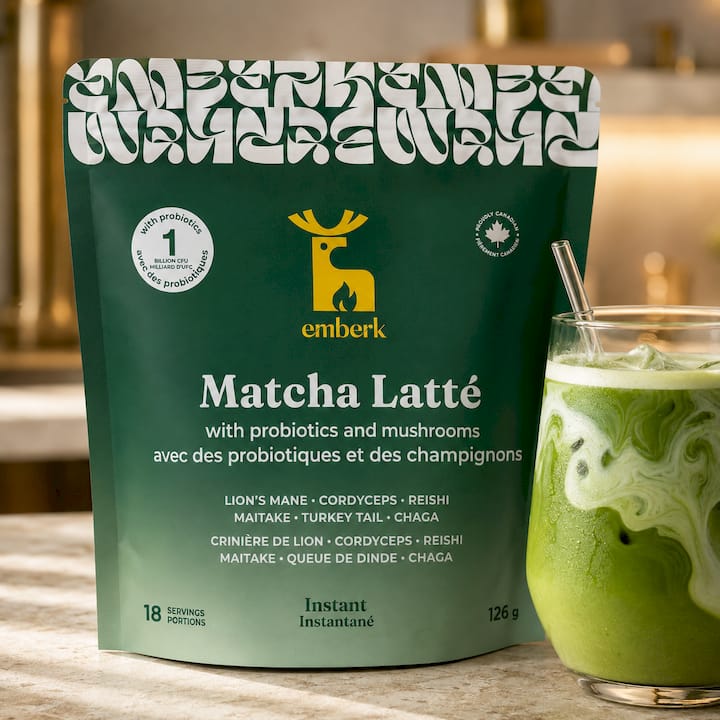
Emberk builds its matcha latte and mushroom latte lines around the same principle this whole category is chasing: calm energy now, real support over time. Every blend uses 100% fruiting body mushrooms, lab-tested with no fillers, and the dairy-free base runs on coconut milk rather than the usual dairy shortcut.
The travel pack format solves a real problem, since consistency is what makes lion’s mane’s slower mechanism worth pursuing in the first place, and a single-serve packet in your bag makes daily use realistic instead of aspirational. Emberk has a customer base that keeps coming back to a routine, not a novelty. For a deeper look at how lion’s mane pairs with caffeinated drinks generally, see lion’s mane coffee benefits and the primer on what lion’s mane is.
How Should You Store Lion’s Mane Matcha to Keep It Fresh?
Matcha degrades faster than most people expect, and lion’s mane extract powder isn’t far behind. Light, heat, air, and moisture are the four things working against potency and flavor, whether you bought a tin of loose blend or a box of single-serve packets.
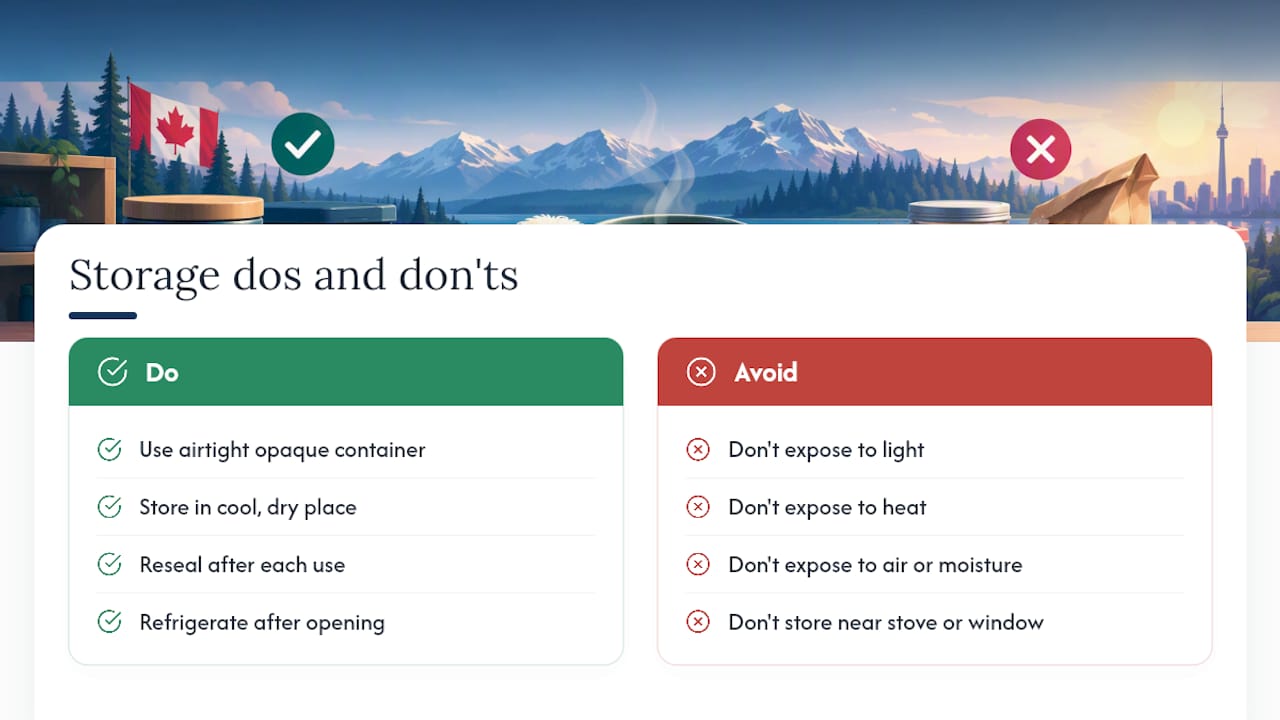
Keep matcha in an airtight, opaque container, since light breaks down the chlorophyll that gives it that vivid green color and much of its fresh, grassy flavor. A tin or a resealable pouch with the air pressed out works better than a clear glass jar left on the counter. Refrigeration extends shelf life once opened, though you’ll want to bring the container to room temperature before scooping, since condensation inside a cold tin invites clumping and mold.
Lion’s mane powder and extracts hold up a bit better against light but are just as vulnerable to moisture. Store both matcha and lion’s mane blends somewhere cool and dry, away from the stove or a sunny window, and reseal the bag tightly after every use.
Most single-serve packets carry a shelf life of twelve to eighteen months unopened, thanks to the protective packaging, while bulk powders in a tin should be used within two to three months of opening for the best flavor and potency. If your matcha has faded to a dull olive color or smells stale rather than grassy and sweet, its antioxidant content has likely dropped along with the taste, even if it’s still technically safe to drink.
Are There Side Effects or Allergy Risks to Know About?
Lion’s mane and matcha are both well tolerated by most people, but “well tolerated” doesn’t mean risk-free for everyone. Mild digestive upset, including bloating or nausea, occasionally shows up when someone starts lion’s mane at a higher dose than their gut is used to; starting with a half serving for the first few days is a reasonable way to test your own tolerance.
Mushroom allergies are uncommon but real, and anyone with a known sensitivity to mushrooms or mold should approach lion’s mane cautiously, watching for skin rash, itching, or respiratory symptoms after the first try. Matcha, meanwhile, carries the same caffeine-sensitivity concerns as any tea or coffee: headaches, restlessness, or a racing heart if you take more than your body handles well, particularly if you’re also taking other caffeinated products the same day.
The interaction risks worth flagging again here: anyone on blood-thinning medication should get medical clearance before regular lion’s mane use, and the same caution applies to people managing autoimmune conditions, since immune-modulating compounds in mushrooms can complicate an already active immune response. Pregnant or breastfeeding people should treat lion’s mane the same way they’d treat any unregulated supplement, meaning a conversation with a doctor before adding it to a routine. None of this makes lion’s mane matcha unusually risky compared to other functional beverages, but it does mean skipping the “natural means automatically safe” assumption.
Is Lion’s Mane Matcha Better Than Taking Either One Alone?
A standalone matcha gives you the acute lift: caffeine and L-theanine working together for calm, sustained attention that fades within a few hours. A standalone lion’s mane supplement, usually in capsule form, skips the caffeine entirely and focuses purely on the slower NGF-related mechanism, which means no immediate feeling of “it’s working” at all, just a bet on cumulative benefit weeks down the line.
Combining them solves a real gap in each. Matcha alone gives you nothing to build on tomorrow; lion’s mane alone gives you nothing to feel today. Together, the drink rewards you in the short term, which makes it far easier to stick with the habit long enough for the lion’s mane mechanism to actually pay off. That’s arguably the biggest practical advantage of the blend: adherence. A capsule that produces no immediate sensation is easy to forget. A latte you look forward to each morning is not.
The tradeoff is dosing clarity. A dedicated lion’s mane capsule almost always states its milligram content plainly, since that’s the entire product. A blended latte buries that number inside a broader ingredient list, and not every brand discloses it with the same rigor. If dosing precision matters more to you than ritual, a standalone supplement alongside your usual matcha or coffee might serve you better than a pre-blended product with vague labeling.
The Editorial Take: What Actually Matters Here
Most coverage of lion’s mane matcha treats dosage as a footnote and taste as the headline. That’s backwards. The single biggest factor separating a product that does something from one that’s mostly flavored water is milligram disclosure, and too many blends on the market still hide behind “proprietary formula” language instead of printing a number.
The conventional advice to “just try it and see how you feel” undersells lion’s mane specifically, because its mechanism doesn’t announce itself the way caffeine does. You won’t feel anything different on day one, and that absence of sensation gets misread as “this doesn’t work” when the honest answer is “you haven’t given it enough time.” Weeks of consistent daily use is the actual test, not a single cup.
If we had to prioritize one thing for a reader starting out: pick a product with a printed milligram count and fruiting-body sourcing, then commit to drinking it daily for at least a month before judging it. Recipe details and matcha grade matter less than that one decision.
— Emberk
Ready to Skip the Guesswork? Try a Ready-Mixed Blend
Measuring matcha and lion’s mane extract by hand every morning is a habit that quietly falls apart on a busy Tuesday. Emberk’s Matcha Latte gives you that same calm focus and cumulative brain support in a single scoop, made with 100% fruiting body mushrooms, lab-tested for potency, and mixed with coconut milk instead of dairy fillers.
If mornings on the move are your reality, the Mushroom Latte Travel Pack solves the packing problem entirely, single-serve pouches with the same sourcing standards, ready wherever you are. Every Emberk product lists its dosing plainly and skips added sugars, artificial ingredients, and fillers, which is exactly the transparency this article has been arguing you should demand from any brand in this category. Browse the full Emberk collection to find the blend that fits your routine, and start your subscription today to keep your mornings consistent without the daily measuring.
This article is general information, not a substitute for advice from a qualified doctor. Consult a qualified healthcare professional about your own circumstances before acting on anything here.
Sources
- Health Canada — Natural and non-prescription health products: regulation overview
- PubMed entry relating to lion’s mane clinical research
- Journal of Clinical Investigation — research on L-theanine and cognitive effects
FAQ
What Is Matcha and Lion’s Mane Good For?
The combination is used for calm, focused alertness in the short term from matcha’s caffeine and L-theanine, plus potential cognitive support from lion’s mane’s NGF-related compounds with consistent daily use over weeks. Most people drink it as a coffee or tea alternative that skips the crash and jitters.
What Should You Not Take Lion’s Mane With?
Anyone on blood-thinning medication should check with a doctor first, since lion’s mane may have mild effects on platelet function. People with autoimmune conditions and those who are pregnant or breastfeeding should also get medical guidance before regular use.
Is Lion’s Mane Legal in Canada?
Yes, lion’s mane is legal in Canada when products meet Health Canada’s safety and labeling requirements for natural health products or foods. Legality mainly depends on accurate ingredient disclosure and appropriate health claims, not the mushroom itself.
Is Lion’s Mane Like Adderall?
No. Lion’s mane does not stimulate the central nervous system the way a prescription stimulant does; its proposed cognitive support works through slower, NGF-related pathways over weeks of use, not an immediate stimulant effect. Any quick alertness in a lion’s mane matcha drink comes from the matcha’s caffeine, not the mushroom.
How Much Does Emberk’s Matcha Latte Cost?
Emberk’s Matcha Latte is priced at $34 for a one-time purchase, available directly through the Emberk product page. Subscription pricing and travel pack options are also listed on the site.
0 comments