

Lion’s mane coffee shows real but modest promise for cognition and mood, backed by a growing pile of small human trials and a mountain of animal research. The catch: most commercial servings deliver less lion’s mane than the doses used in those studies. Think of it as a gentle nudge toward the benefits you’ve read about, not the full clinical dose in a cup. It’s worth trying for the taste and smoother energy, but if you want the effects seen in trials, you’ll likely need a standardized supplement, too. Anyone pregnant, nursing, on medication, or allergic to mushrooms should check with a doctor first.
TL;DR:
- Most mushroom coffees contain less lion’s mane than the doses shown to improve cognition and mood in clinical trials, typically providing only a small fraction of effective amounts.
- Animal and cell studies suggest nerve growth stimulation from lion’s mane compounds, but these findings have not reliably transferred to the lower doses in coffee.
- Standard effective doses in trials range from 750 to 3,000 milligrams daily, while typical coffee servings contain about 100 to 250 milligrams in total, with lion’s mane usually as one ingredient.
- Side effects are rare at food-level doses, but some individuals may experience mild stomach upset, headaches, or allergic reactions; caution is advised for pregnant or immunocompromised people.
- For noticeable cognitive or mood benefits, a concentrated supplement is likely more effective than coffee alone, which provides only a modest and indirect dose of active compounds.
Table of Contents
- What Is Lion’s Mane Coffee, Exactly?
- Does Lion’s Mane Coffee Actually Work? The Evidence So Far
- How Lion’s Mane Is Believed to Work in Your Brain
- How Much Lion’s Mane Do You Actually Get in a Cup?
- Is Lion’s Mane Safe? Side Effects to Know
- How to Choose and Use Lion’s Mane Coffee Well
- Where the Hype Outpaces the Science
- Try Emberk’s Lion’s Mane Coffee Blend
- Sources
- FAQ
What Is Lion’s Mane Coffee, Exactly?
Lion’s mane coffee is regular coffee, usually instant, blended with an extract or powder from Hericium erinaceus, the shaggy white mushroom that looks a bit like a lion’s mane draped over a tree branch. Brands often stack it alongside other functional mushrooms, chaga for antioxidants, reishi for calm, cordyceps for stamina, but lion’s mane gets top billing because it’s the one most associated with brain function.
You’ll find it in three main formats:
- Instant mixes that dissolve in hot water, closest to traditional instant coffee.
- Ground blends meant for a drip machine or French press.
- Latte mixes, often paired with functional additions like MCT oil or probiotics.
The label matters more than the format. Look for whether the mushroom is listed as fruiting body (the part that grows above ground, generally richer in the compounds tied to cognitive effects) or mycelium (the root-like network, cheaper to produce but often diluted with the grain it’s grown on). A product that says “standardized extract” should specify to what, usually a percentage of beta-glucans or polysaccharides. Vague blends without a milligram count are a red flag.
Does Lion’s Mane Coffee Actually Work? The Evidence So Far
A 2025 systematic review in Frontiers in Nutrition pooled the available research on Hericium erinaceus and found a consistent, if modest, signal: small randomized controlled trials point to real neuroprotective and mood benefits, but the total body of clinical evidence remains thin. That’s the honest headline. The mushroom isn’t a myth, but it isn’t a miracle, either.
The strongest human data comes from a handful of trials, not a mountain of them.
- A widely cited 2009 trial by Mori and colleagues gave older adults with mild cognitive impairment 3 grams of lion’s mane powder daily for 16 weeks and found measurable improvement on cognitive function scales, effects that faded after supplementation stopped.
- Later small trials have tested lion’s mane for mood and mild anxiety symptoms over similar multi-week windows, generally reporting modest improvements rather than dramatic ones.
- Effect sizes across this research tend to be small to moderate, and sample sizes are often under 50 participants.
Animal and cell studies tell a more dramatic story, but with an asterisk. Lab research shows lion’s mane compounds stimulating nerve growth factor and supporting markers of new neuron growth, which is exciting biology. The problem is translation: what happens in a petri dish or a mouse brain doesn’t automatically happen in a human sipping coffee. Harvard Health points out that nearly every clinical study testing cognitive benefits used a concentrated extract, not a coffee blend, which is the gap this whole category has to reckon with.
Here’s the number that should anchor your expectations: most mushroom coffee servings provide less lion’s mane than the amounts used in the trials that produced these results. You’re drinking a lighter version of the intervention that worked in the lab.
How Lion’s Mane Is Believed to Work in Your Brain
Picture your brain as a bustling city, and nerve growth factor, or NGF, as the crew responsible for building and maintaining the roads between neighborhoods. Without steady road maintenance, traffic (your thoughts) slows down. Lion’s mane contains compounds that appear to stimulate NGF production, which is the mechanism researchers believe underlies its reputation for supporting focus and memory.
Two compound families do the heavy lifting, and they come from different parts of the mushroom:
- Erinacines are found primarily in the mycelium and have shown strong NGF-stimulating activity in lab studies.
- Hericenones come from the fruiting body and are linked to similar neurotrophic effects, though through a slightly different pathway.
- Beta-glucans, a type of fiber found throughout the mushroom, support immune modulation and act like tiny fire extinguishers for oxidative stress, putting out cellular sparks before they spread.
None of this guarantees a payoff at coffee-cup doses. Mechanistic plausibility, the “this could work” science, is not the same as a proven clinical outcome at the low concentrations found in a daily brew.
Pro Tip: If cognitive support is your main goal, check whether a product highlights its erinacine or hericenone content specifically, rather than just listing “lion’s mane extract” with no further detail.
How Much Lion’s Mane Do You Actually Get in a Cup?
This is where the gap between hype and reality shows up most clearly. Clinical trials showing measurable cognitive or mood benefits typically used 750 to 3,000 milligrams of lion’s mane extract per day, often taken consistently for eight to sixteen weeks.
A typical serving of mushroom coffee, by contrast, generally contains somewhere in the range of 100 to 250 milligrams of total mushroom blend, and lion’s mane is frequently just one ingredient among several in that blend. Do the math and you’re often getting a small slice of a single trial dose, in a single cup.
- Clinical trial doses: roughly 750–3,000 mg/day of lion’s mane extract, isolated.
- Typical mushroom coffee serving: roughly 100–250 mg total blend, with lion’s mane as one component.
- Caffeine per cup: mushroom coffee often lands around 35 to 60 milligrams, compared with 80 to 100 milligrams in a standard brewed cup.
That caffeine difference is not a footnote, it’s often the more noticeable effect day to day — you can read more about how caffeine impacts bone health here. Lower caffeine means less risk of the mid-afternoon crash or the wired, jittery feeling that comes with a stronger brew, which is part of why so many people switch in the first place. If cognitive support is your primary goal, closing the dosage gap usually means drinking mushroom coffee consistently over weeks, not expecting a jolt from one cup, or pairing it with a more concentrated supplement.
Is Lion’s Mane Safe? Side Effects to Know
Lion’s mane has a solid safety record at food-level exposure, which is reassuring given how many people now drink it daily. Memorial Sloan Kettering notes that it’s generally well tolerated in food forms, though some people report mild issues.
- Stomach upset, including bloating or nausea in sensitive individuals.
- Headaches, reported in a small subset of users, particularly at higher doses.
- Allergic reactions, which are rare but possible, especially for anyone with existing mushroom or mold sensitivities.
Case reports of more serious adverse events tend to involve prolonged use of concentrated supplements, not coffee-level servings, which is an important distinction. Food-level exposure, the amount in a daily cup, carries a different risk profile than a high-dose capsule regimen.
Talk to a clinician before starting if you’re pregnant or nursing, have a known mushroom allergy, or take medications that affect immune function or blood clotting, since lion’s mane can theoretically interact with both. If you notice a severe reaction, hives, difficulty breathing, persistent GI distress, stop immediately and seek medical advice.
How to Choose and Use Lion’s Mane Coffee Well
Picking a good product comes down to reading past the marketing copy on the front of the bag.
- Check the mushroom form. Fruiting body extracts or clearly stated standardized extracts tend to reflect the compounds studied in research more accurately than vague “mushroom blend” labels.
- Look for a milligram count per serving, not just an ingredient list. If a brand won’t disclose dosage, it’s harder to know what you’re actually consuming.
- Verify third-party lab testing, and if you’re shopping in Canada, a product carrying a Natural Product Number (NPN) has passed a regulatory review for its health claims.
- Decide your goal first. If you want measurable cognitive effects similar to trial results, a standalone standardized supplement will likely outperform coffee. If you want a smoother energy profile with incremental benefits, mushroom coffee is a reasonable everyday choice.
- Track your own results. Note focus, mood, and energy for four to twelve weeks, since that’s the window where trial participants saw changes.
Pro Tip: Drink it in the morning if you’re caffeine-sensitive. The lower caffeine load, often 35–60 mg per cup, still carries enough stimulation to disrupt sleep if consumed too late in the day.
Where the Hype Outpaces the Science
Most marketing around mushroom coffee leans on the exciting animal studies and skips the fine print about dosage. That’s the gap Emberk designed around from the start.
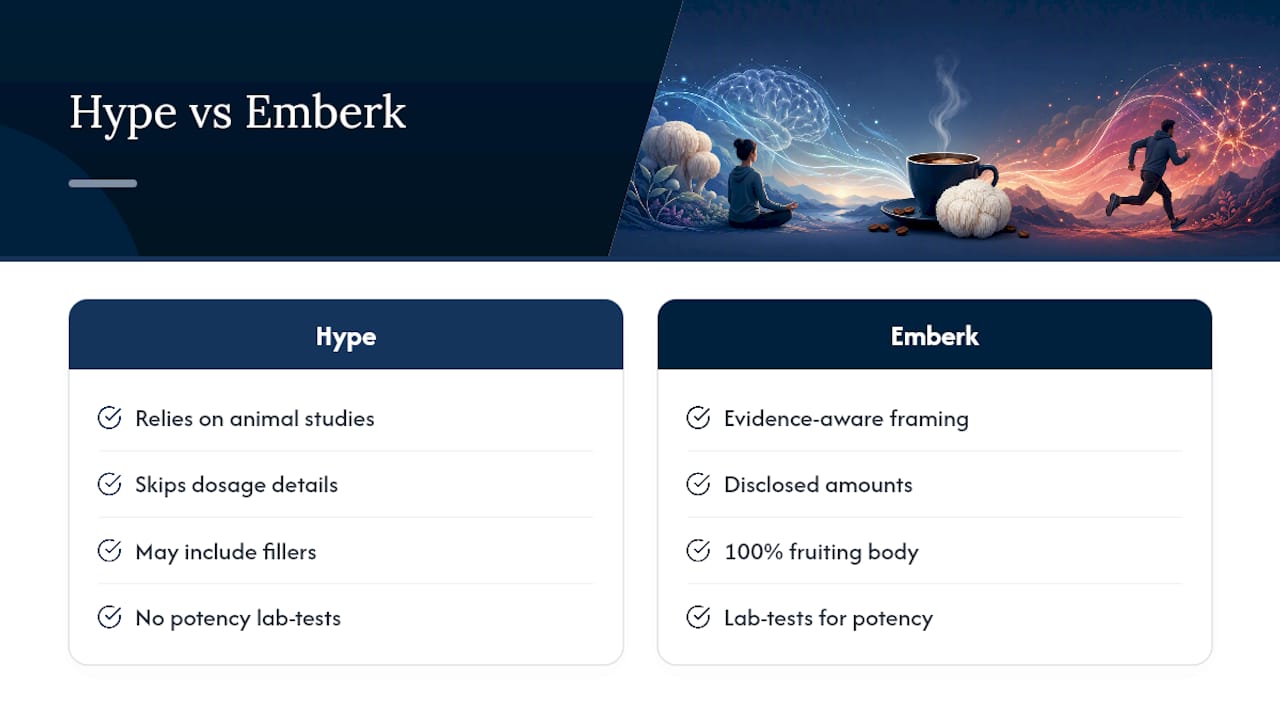
Emberk builds every blend from 100% fruiting body mushrooms, lab-tests for potency, and skips fillers that dilute the active compounds, decisions made specifically because dosage transparency is the difference between a product that might work and one that’s mostly marketing. We don’t pretend a cup of coffee replicates a clinical trial. What we’ve tried to build is the most evidence-aware version of this category: real fruiting body extract, disclosed amounts, and a moderate caffeine profile that avoids the jitters and crashes tied to traditional coffee.
The honest position is this: lion’s mane coffee is a reasonable daily habit with plausible, modest upside, not a substitute for concentrated supplementation if cognitive performance is your specific goal. Readers deserve that distinction more than another glowing product claim.
— Tatiana
Try Emberk’s Lion’s Mane Coffee Blend
If the label checklist above sounds like a lot to verify on your own, Emberk’s mushroom coffee is built around exactly those standards: 100% fruiting body lion’s mane, lab-tested for potency, no fillers, and a caffeine profile that stays in the moderate range instead of spiking and crashing.
Every blend lists what’s actually in the cup, so you’re not guessing at milligrams or wondering whether you got mycelium filler instead of real fruiting body extract. Emberk also blends in five additional functional mushrooms, chaga, reishi, turkey tail, maitake, and cordyceps, for broader wellness support beyond cognition alone. Browse the full product lineup if you want to compare formats, including lattes and matcha, and subscribe for regular delivery if you’re planning to test it over the four-to-twelve-week window that matters most for noticing results.
Sources
- Benefits, side effects, and uses of Hericium erinaceus as a supplement: a systematic review
- Lion’s Mane Mushroom | Memorial Sloan Kettering Cancer Center
- Mushroom coffee: Worth a taste? | Harvard Health Publishing
FAQ
What’s the downside of mushroom coffee?
The main downside is dosage: most commercial blends provide far less lion’s mane than the amounts used in clinical trials, so the cognitive effects may be smaller than marketing suggests. Some people also report mild stomach upset or headaches, and taste or texture can differ from traditional coffee.
What does lion’s mane do to your body?
Research suggests lion’s mane may stimulate nerve growth factor production, support mild mood improvements, and offer antioxidant and immune-supporting effects through its beta-glucan content. Most of this evidence comes from small human trials and animal studies using doses higher than a typical cup of mushroom coffee provides.
Is lion’s mane good for ADHD?
There isn’t reliable clinical evidence specifically testing lion’s mane for ADHD, so any claim connecting the two is speculative rather than proven. The existing research focuses on general cognitive support and mild cognitive impairment, not attention disorders specifically.
What are the bad side effects of lion’s mane?
Reported side effects are generally mild and include stomach discomfort, headaches, and occasional allergic reactions, particularly in people with existing mushroom sensitivities. Anyone pregnant, nursing, or taking immune-modulating or blood-thinning medications should consult a clinician before regular use, since food-level exposure and high-dose supplementation carry different risk profiles.
0 comments