

Yes, matcha functions as a natural nootropic: its caffeine plus L-theanine combination reliably supports sustained attention and task endurance more than isolated caffeine alone. The strongest evidence points to attention, focus, and flow during demanding tasks, not to mood repair or clinical-grade executive function gains. The catch is that these benefits show up with regular, moderate intake, not a single big cup before a deadline.
TL;DR:
- Matcha’s cognitive benefits depend on regular, moderate intake rather than single large cups before demanding tasks.
- The synergy of caffeine, L-theanine, and catechins in matcha supports steady attention, stress resilience, and reduced mental fatigue over time.
- Most research backing matcha’s nootropic effects comes from small studies focusing on attention and alertness, not mood or broad executive functions.
- Ceremonial-grade matcha from reputable sources provides higher levels of L-theanine and consistent quality for cognitive support.
- Overconsumption can cause jitters and sleep issues, so moderate daily servings, especially for pregnancy or medication users, are safest.
Table of Contents
- What Makes Matcha a Nootropic in the First Place?
- What Does the Clinical Research Actually Show?
- What Can You Realistically Expect From Matcha?
- How Much Matcha Is Safe, and Who Should Be Careful?
- How Do You Choose a Quality Nootropic Matcha?
- Why Consistency Beats a Big Dose Every Time
- A Daily Ritual Built for Sustained Focus, Not a Caffeine Spike
- Sources
- FAQ
What Makes Matcha a Nootropic in the First Place?
Matcha earns its nootropic reputation from three compounds working as a team rather than any single ingredient acting alone. Understanding each one helps explain why matcha feels different from a plain cup of coffee.
Caffeine is the obvious driver of alertness, but matcha delivers it differently than coffee does. Research on green tea phytochemicals shows measurable effects on attention starting at doses as low as 40 milligrams, which is a fraction of what’s in a typical brewed coffee. This lower caffeine content compared to coffee means matcha can sharpen focus with a smoother stimulant effect that many find less jittery.
L-theanine is matcha’s counterbalance. This amino acid promotes relaxation by encouraging alpha brain wave activity, the same pattern associated with a calm, wakeful state rather than drowsiness. It’s part of why matcha drinkers describe a “clear headed” feeling instead of the jagged edge that comes with straight espresso.
EGCG and other catechins round out the profile. These antioxidant compounds appear to support neuroprotection, though the human evidence here is thinner than for caffeine and theanine. Think of catechins as a support crew rather than the main event.
The real story is the synergy. A systematic review of green tea phytochemicals found that caffeine and L-theanine together improve attention-switching and alertness in ways that outperform either compound alone. That combination is the mechanism behind most of matcha’s cognitive claims.
- Caffeine sharpens alertness at low doses, often below what’s found in a standard coffee.
- L-theanine tempers the jitteriness that pure caffeine can trigger.
- Catechins like EGCG add antioxidant support with a more modest evidence base.
- Together, they produce steadier attention than either compound delivers solo.
Pro Tip: If you’ve tried quitting coffee because of the crash and anxiety, matcha’s caffeine-theanine pairing is worth testing before writing off caffeinated drinks altogether. The chemistry, not just the ritual, is what changes the experience.
What Does the Clinical Research Actually Show?
The human evidence for matcha as a cognitive tool is real, but it’s also modest in scope. Most trials are small, and the outcomes measured vary enough that comparing them directly gets tricky.
The clearest signal comes from the same systematic review of L-theanine and caffeine combinations, which found consistent improvements in attention-switching tasks and alertness across 49 human interventions. That’s the backbone finding almost every matcha cognition claim traces back to.
More matcha-specific evidence comes from a 12-week randomized, double-blind, placebo-controlled trial using 3 grams of daily matcha powder. Participants showed improvements in certain attention and executive function measures, with some subgroups showing signals that suggested protective effects against age-related cognitive decline. That’s a meaningful data point, though “some subgroups” is doing a lot of work in that sentence, and it’s not a blanket claim for every drinker.
A broader review of matcha’s therapeutic potential, drawing on both human and animal research, found that matcha’s combined caffeine, theanine, and catechin profile helps maintain attention and performance under stress. Supporting mechanistic work, including neuroimaging studies on green tea extract, has even found increased connectivity in the brain’s parieto-frontal network during working-memory tasks, offering a plausible biological explanation for why attention improves.
None of this means matcha is a cure-all. The limitations are worth taking seriously:
- Sample sizes across most matcha-specific trials are small, often in the dozens rather than hundreds.
- Endpoints vary widely between studies, from reaction time to subjective flow scores, making direct comparisons difficult.
- Mood outcomes are mixed at best, with far less consistency than attention outcomes.
The pattern across these trials is consistent even when the specific measurements differ: attention and sustained task performance respond to matcha’s compound combination, while mood and broader executive function show weaker, less reliable effects.
The practical implication is straightforward. If you’re chasing better mood or a general brain boost, matcha is not a strong bet on its own. If you want steadier attention through a long task, especially under stress, the evidence is on your side.
What Can You Realistically Expect From Matcha?
Matcha earns its keep in a specific lane: sustained attention, reduced mental fatigue, and better flow states during focused work. It’s not built to fix everything your brain struggles with.
- Sustained attention has the strongest backing. The caffeine and L-theanine combination consistently improves attention-switching and reduces distraction in controlled studies.
- Flow and short-task performance get a real lift too. A controlled study published in PLOS One found that even small doses of green tea rapidly improved flow scores and maintained arousal during short, demanding mental tasks.
- Reduced mental fatigue during longer work sessions shows up in trials tracking continuous daily intake, particularly when compared against caffeine alone.
What doesn’t hold up as well: broad mood elevation, anything resembling clinical ADHD treatment, or sweeping executive function gains. Matcha is not a substitute for medication, and treating it as one sets you up for disappointment.
The acute-versus-consistent distinction matters here. A single cup of matcha gives you a caffeine-plus-theanine hit similar to a mild energy boost. If you’re studying for finals, prepping for a big presentation, or grinding through a deadline-heavy week, matcha works best as your daily companion, not your emergency reserve.
Pro Tip: Save matcha for tasks that require sustained focus over 30 to 90 minutes, like deep work blocks or study sessions. For quick bursts of energy, the flow-state research suggests you don’t need much: a small serving is enough.
How Much Matcha Is Safe, and Who Should Be Careful?
A standard serving of matcha, roughly one to two grams of powder whisked into water or milk, typically delivers a moderate amount of caffeine alongside meaningful L-theanine content. That’s noticeably gentler than a drip coffee, which often runs 95 milligrams or more per cup.
Most healthy adults tolerate moderate daily servings without issue, especially since matcha’s caffeine profile is smoother than coffee’s spike. But a few groups need to pay closer attention:
- Pregnant people should keep total caffeine intake conservative and check with a clinician before making matcha a daily habit.
- People on anticoagulant medication need to know that matcha contains meaningfully higher concentrations of vitamin K than brewed green tea, which can interfere with blood-thinning drugs like warfarin.
- Anyone on stimulant medication or thyroid medication should ask a doctor before layering in a caffeine source, since interactions can amplify heart rate or disrupt medication timing.
Overconsumption signs are the usual caffeine tells: racing heart, disrupted sleep, jitteriness, or a stomach that feels unsettled on an empty cup. If any of that shows up, cut your serving size in half before cutting matcha out entirely. Since the cognitive benefits come from consistency rather than a big dose, a smaller daily habit often works better than a large occasional one anyway.
How Do You Choose a Quality Nootropic Matcha?
Not all matcha delivers the same nootropic punch, and the grade printed on the tin matters more than most shoppers realize.
Ceremonial-grade matcha comes from the youngest, shade-grown tea leaves, and it consistently tests higher for L-theanine content than culinary-grade matcha, which is typically blended for baking and cooking rather than drinking straight. If you’re buying matcha specifically for cognitive benefits, ceremonial grade is the more reliable choice, and it tastes smoother too, which matters if you’re committing to a daily ritual.
Beyond grade, a few label details separate a genuinely useful product from marketing dressed up as science:
- Origin transparency: reputable brands name the growing region, often Japan, rather than staying vague.
- Third-party lab testing: look for verification of caffeine content, heavy metals, and contaminants, not just a claim on the box.
- Ingredient list: shorter is better. Fillers, artificial flavoring, or added sugars dilute both the flavor and the nootropic value.
- Vitamin K disclosure: matters most if you or someone in your household is on anticoagulants.
Some products go further by blending matcha with functional mushrooms like Lion’s Mane or Reishi, or adding MCT oil for sustained energy. These additions can extend the calm, focused profile matcha already offers, though the research base for mushroom cognitive effects is still younger and thinner than the matcha evidence itself. Treat those blends as a reasonable bet, not a guaranteed upgrade.
A quick daily-use checklist:
- Confirm ceremonial grade if cognition is your goal.
- Check for named origin and third-party testing.
- Scan the ingredient list for fillers or added sugar.
- Note the caffeine and L-theanine content if listed.
- Decide whether an added ingredient, like mushrooms or MCT, fits your goals.
Why Consistency Beats a Big Dose Every Time
Here’s where most people get matcha wrong: they treat it like a supplement they can dose up before a big test, the same way they’d down an extra espresso shot. That’s backwards. The trial data that shows the most convincing attention and stress-resilience benefits comes from continuous, weeks-long intake, not a single loaded cup.
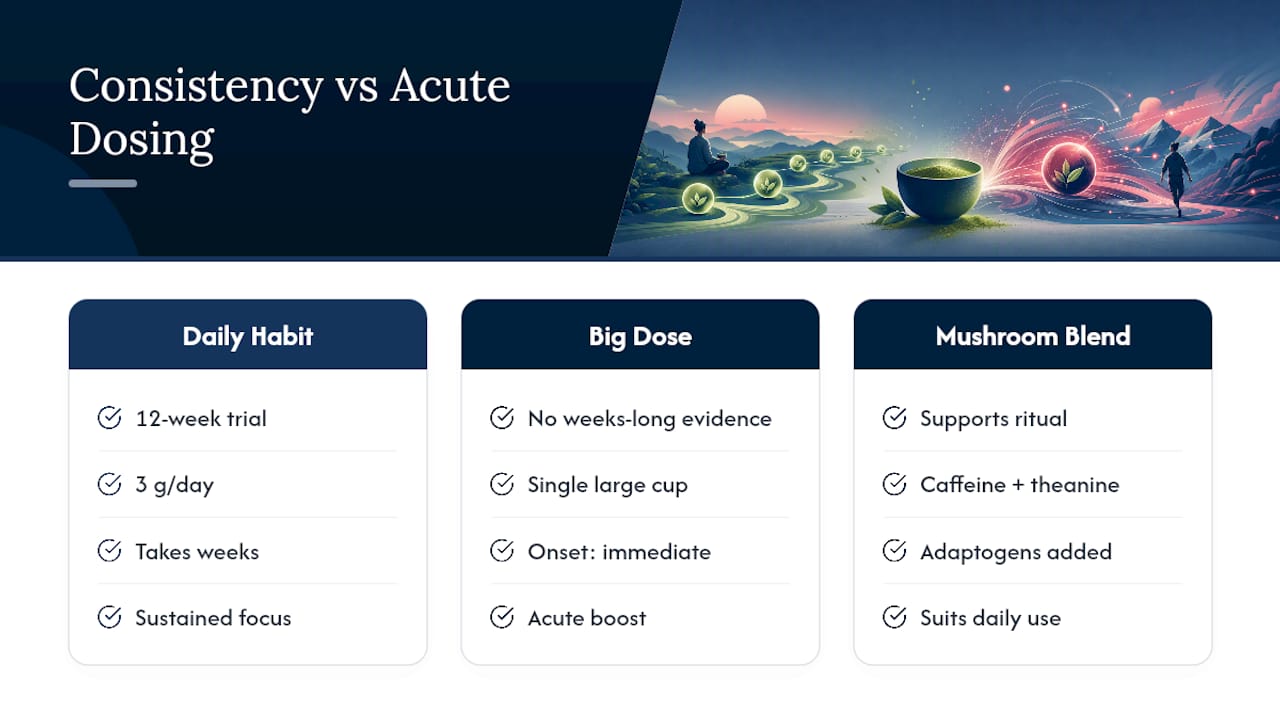
That distinction changes how you should think about matcha entirely. It’s less like a pre-workout and more like a daily habit that compounds. The 12-week trial showing cognitive benefits used a steady 3 grams a day, not an escalating dose. The flow-state research showing quick benefits used small servings, not large ones. Across the board, the pattern favors moderation and repetition over intensity.
This is also where a blended, mushroom-forward approach to a morning ritual makes sense as a category, not just a flavor choice. Combining matcha’s evidence-backed caffeine-theanine profile with adaptogenic mushrooms addresses a real gap: most people don’t want a single-purpose stimulant, they want a sustainable daily ritual that doesn’t wreck their afternoon. Some brands build their coffee and matcha lineups around functional mushrooms sourced sustainably with no fillers, reflecting an evidence-first logic: consistency and ingredient quality over acute stimulation. Whether you buy into mushroom-matcha blends or stick with straight ceremonial matcha, the lesson from the research holds either way. Show up daily, keep the dose modest, and give it weeks rather than days to show its effects.
— Tatiana
A Daily Ritual Built for Sustained Focus, Not a Caffeine Spike
If the research points to consistency over intensity, the product you choose should support that same habit, not fight it. Some blends are built around this approach: moderate caffeine paired with functional mushrooms like Lion’s Mane and Reishi, so your focus builds steadily instead of spiking and crashing by 2 p.m.
Every Emberk blend uses 100% fruiting body mushrooms with no fillers, added sugars, or artificial ingredients, sourced sustainably and lab-tested for consistency. That matters if you’re the kind of reader who just read through vitamin K interactions and third-party testing standards and actually wants those boxes checked before buying. For a daily attention ritual that pairs matcha’s caffeine-theanine profile with broader adaptogenic support, the mushroom coffee line is a natural starting point, and the mushroom latte offers an easy, ready-to-mix option for mornings when you want less prep and the same calm-focus payoff. Starting with a single order can help build a habit consistent with the evidence on sustained intake.
Sources
- Effect of Green Tea Phytochemicals on Mood and Cognition (systematic review)
- Randomized trial: daily matcha supplementation and cognitive function (PMC7760932)
- Green tea consumption rapidly enhances cognitive performance and flow state during mental tasks (PLOS One)
FAQ
Are Nootropic Drinks Like Matcha Safe to Drink Daily?
For most healthy adults, yes. Matcha’s typical serving delivers caffeine alongside L-theanine, a gentler combination than a standard coffee, though pregnant people and those on anticoagulants or stimulant medication should check with a clinician first.
What Is the Downside of Nootropics Like Matcha?
The main downside is overstated expectations: matcha reliably supports attention and task endurance but shows weak, inconsistent evidence for mood improvement or broad executive function gains, and overconsumption can still cause jitteriness or sleep disruption.
Why Is Matcha Often Discussed for ADHD or Focus Issues?
Matcha is not a clinical ADHD treatment, but its caffeine and L-theanine combination consistently improves attention-switching and reduces distraction in controlled studies, which is likely why it gets discussed in focus-related conversations.
What Does Matcha Actually Do for Your Brain?
Matcha’s caffeine, L-theanine, and catechins work together to support sustained attention and may increase parieto-frontal connectivity during working-memory tasks, though evidence for broader cognitive changes remains limited.
Does Matcha Work Better as a Daily Habit or an Occasional Boost?
The clinical trial evidence, including a 12-week study using 3 grams daily, consistently favors regular intake over occasional high-dose use for measurable cognitive benefits.
0 comments