

Standardized maitake extracts containing D-fraction and beta-glucan polysaccharides have improved immune markers like NK cell activity and CD4+ T-cell counts in small human trials. The evidence is real but early: most studies are small, use different extracts, and measure immune markers rather than fewer colds or infections. Whole culinary maitake carries little risk either way. If you’re on blood thinners or diabetes medication, read the safety section below before adding it to your routine.
TL;DR:
- Most clinical evidence concerns purified maitake extracts, particularly D-fraction, which can vary in dose and extract type, affecting immune responses.
- These extracts activate immune cells by targeting Dectin-1 and TLR4 receptors, leading to increased cytokine production and NK cell activity, but product processing influences effectiveness.
- Whole culinary maitake provides some immune support but contains lower bioactive polysaccharides than clinical extracts, making standardized supplements more predictable.
- Safety is generally good for healthy adults, but those on blood thinners, diabetes medication, or with chronic illnesses should consult a healthcare professional before supplementing.
- The strongest evidence shows immune marker modulation rather than a confirmed reduction in illness frequency, so use supplements cautiously and focus on overall immune health practices.
Table of Contents
- What Do Human Trials Say About Maitake for Immunity?
- How Does Maitake Actually Activate Your Immune Cells?
- Which Maitake Product Actually Matches the Research?
- Is Maitake Safe, and What Should You Watch For?
- How Should You Actually Use Maitake for Immune Support?
- What’s the Honest Take on Maitake and Immunity?
- A Simpler Way to Get Maitake Into Your Morning
- Primary Sources and Further Reading
- Sources
- FAQ
What Do Human Trials Say About Maitake for Immunity?
The strongest human data on maitake comes from a specific extract, not the mushroom itself. Fraction D, sometimes labeled GFP-D, is a purified polysaccharide compound isolated from maitake’s fruiting body, and it’s the version researchers have studied most closely in people. Clinical work on this extract reported increases in CD4+ T cell counts and NK cell activity alongside a shift toward Th1 cytokines, the signaling proteins that help coordinate your body’s response to intruders. These trials also found dose-dependent patterns: lower doses nudged immune markers in otherwise healthy volunteers, while higher doses showed adjunctive effects in oncology settings, which tells you a lot about why “how much maitake” is never a one-size-fits-all answer.
A separate line of research looked at short-term oral glucan supplementation, comparing maitake extracts against another well-known mushroom compound called AHCC. Over 14 days, maitake ranked among the strongest stimulants for phagocytosis (the process by which immune cells engulf and destroy pathogens), NK cell activity, and cytokines including IL-6, IL-12, and IFN-γ. A 2026 trial testing a formulation called maitake Y10M found it may reduce upper respiratory tract infection symptom burden while modulating innate immune responses, one of the few studies to look past lab markers toward something closer to how you’d actually feel.
What the evidence actually supports:
- Consistent immunomodulatory signals across preclinical and small clinical studies
- Measurable changes in specific immune markers (NK activity, cytokines, CD4+ counts)
- One trial found supplementation possibly associated with reduced respiratory symptom burden
- No large-scale trials confirming fewer infections or shorter illness duration
By the numbers: In the glucan study referenced above, researchers tracked immune response over a 14-day supplementation window, short enough to show real physiological signals but far too brief to draw conclusions about long-term protection.
A comprehensive 2024 review of maitake’s bioactive compounds noted that multiple polysaccharide fractions consistently activate macrophages, NK cells, and T-cells across the research base, which is reassuring in terms of biological plausibility. But the same review, along with a clinical summary from Memorial Sloan Kettering Cancer Center, is careful to note that sample sizes remain small, extraction methods vary widely between studies, and most endpoints measure lab markers rather than whether people actually get sick less often. Breastcancer echoes this caution specifically for people managing cancer, noting that research in that population is still very early. Promising signal, incomplete picture.
How Does Maitake Actually Activate Your Immune Cells?
Think of your immune system as a city’s emergency response network. Most of the time, it’s on standby, but certain signals tell it to mobilize. Maitake’s polysaccharides, particularly D-fraction and beta-glucans, act like a dispatch call your body recognizes instantly.
Beta-glucans are long chains of sugar molecules that your immune cells have evolved to detect as a hallmark of fungal and microbial threats. When these compounds bind to a receptor called Dectin-1 on the surface of macrophages and dendritic cells, and to TLR4 (Toll-like receptor 4), they trigger a cascade: macrophages get activated, natural killer cells ramp up their surveillance, and your body increases production of cytokines like IL-2 and IFN-γ, chemical messengers that coordinate the broader immune response.
- Dectin-1 activation triggers macrophages to engulf pathogens more aggressively
- TLR4 signaling amplifies the inflammatory alert system in a controlled way
- Cytokine production (IL-2, IFN-γ) recruits and coordinates other immune cells
- NK cell stimulation boosts your body’s ability to identify and destroy compromised cells
Here’s the catch that most consumer articles skip: how maitake is processed changes everything about whether it can actually deliver these effects. Water extraction pulls out polysaccharides differently than alcohol extraction, and fruiting body preparations concentrate different compounds than mycelium grown on grain. A comprehensive review of maitake’s chemistry makes clear that these manufacturing choices directly affect polysaccharide concentration, and by extension, whether lab results on a specific extract will translate to a bottle sitting on a store shelf.
Pro Tip: If a product doesn’t specify whether it’s made from fruiting bodies or mycelium, or how the polysaccharides were extracted, you’re essentially buying a mystery. The compound that worked in a clinical trial and the compound in a random capsule may share a name but very little else.
Which Maitake Product Actually Matches the Research?
Not every maitake product on the shelf resembles what researchers actually tested. That gap matters more than most supplement marketing lets on.
Culinary maitake, the kind you’d sauté fresh or rehydrate from dried slices, delivers polysaccharides along with fiber, vitamin D precursors, and genuine flavor, but at concentrations far below what clinical extracts provide. Whole-fruiting-body powders sit a step up, offering a more concentrated but still whole-food version. Mycelium-on-grain supplements, grown on rice or oats rather than harvested from the mushroom’s cap and stem, tend to contain lower and less consistent polysaccharide levels, since much of the bioactive material clinical trials measured comes from the fruiting body itself. Concentrated extracts, like the GFP-D fraction used in trials, are formulated specifically to isolate and standardize the compounds researchers tracked.
The GFP-D trials reported specific dosing protocols tied to their outcomes, distinct from what you’d get eating maitake in a stir-fry, which is exactly why label-reading matters here more than with most supplements.
Before buying, check for:
- Fruiting body sourcing, not mycelium-on-grain, if you’re targeting the immune effects studied in trials
- Third-party testing confirming actual polysaccharide content, not just “proprietary blend” language
- Quantified beta-glucan or D-fraction percentage on the label
- No fillers, starches, or grain additives diluting the active compound
A look at fruiting body versus mycelium products breaks down why this distinction changes what you’re actually paying for.
Is Maitake Safe, and What Should You Watch For?
Maitake has a solid safety record across the trials reviewed by Memorial Sloan Kettering, with most participants tolerating it well and few adverse events reported beyond mild digestive upset in some cases. That said, a few groups need to pay closer attention.
- If you take diabetes medication: Maitake may lower blood sugar, and combining it with insulin or oral hypoglycemics could push levels too low.
- If you take anticoagulants or antiplatelet drugs: Some evidence suggests maitake may affect blood clotting, so combining it with blood thinners warrants a conversation with your prescriber first.
- If you’re pregnant, nursing, or scheduled for surgery: Data in these situations is too thin to call it safe by default, so pause use and check with a clinician.
- If you have a chronic condition like cancer or an autoimmune disorder: Immune-modulating supplements can interact with treatment plans in ways that aren’t always obvious, so loop in your care team before starting.
None of this means maitake is risky for the average healthy adult eating it as food. It means the supplement version, particularly concentrated extracts, deserves the same respect you’d give any compound that measurably changes immune activity.
How Should You Actually Use Maitake for Immune Support?
Food-first is the lowest-risk entry point, and this is why many choose to order freshly prepared meals that incorporate immune-supporting ingredients like maitake mushrooms. Fresh maitake sautéed in a little olive oil develops a rich, almost smoky flavor that holds up well in soups, stir-fries, or roasted alongside other vegetables. Dried maitake rehydrates easily and works well simmered into broths, where its texture and flavor come through without much prep effort.
If your goal is specifically immune-marker support rather than dinner, a standardized extract makes more sense than culinary use alone. Start at the lower end of a product’s labeled dose, watch how you feel over several weeks, and don’t expect overnight results.
- Choose extracts labeled with quantified beta-glucan or D-fraction content if immune markers are your goal
- Start with a modest dose and monitor your response before increasing
- Don’t expect it to replace sleep, diet, or vaccination as your immune foundation
- Track how you feel for colds and fatigue, but understand marker changes in trials often showed up over weeks, not days
Pro Tip: The respiratory-symptom trial mentioned earlier tracked outcomes over an extended supplementation period, not a few days. If you’re testing maitake for yourself, give it a comparable runway before deciding whether it’s doing anything.
A deep dive into how mushroom coffee blends deliver these compounds shows how food-based delivery can fit into a daily routine without turning supplementation into a chore.
What’s the Honest Take on Maitake and Immunity?
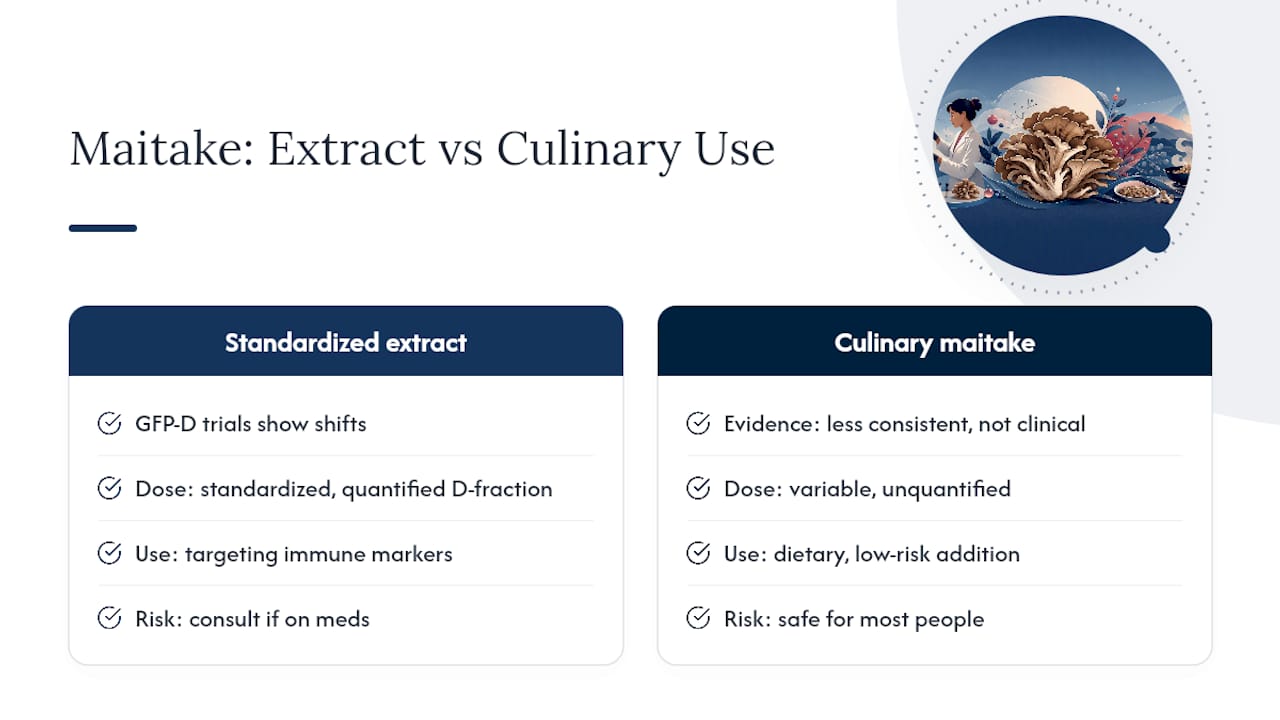
The clinical picture on maitake is genuinely promising, but it’s not the slam dunk some wellness marketing suggests. GFP-D trials show real, measurable shifts in immune markers, and the mechanistic story, beta-glucans binding Dectin-1 and TLR4, holds up under scrutiny. What’s missing is the leap from “NK cells got more active in a lab test” to “you’ll catch fewer colds this winter.” That gap is where I’d urge caution.
If your goal is targeting immune markers specifically, a standardized extract with quantified D-fraction content makes more sense than hoping culinary maitake delivers the same dose. If you just want a low-risk addition to your diet, cooking with maitake is safe for nearly everyone. Either way, talk to your clinician first if you’re on blood thinners, diabetes medication, or managing a chronic illness.
— Tatiana
A Simpler Way to Get Maitake Into Your Morning
Reading ingredient labels and comparing extraction methods takes real effort, and most people don’t have time to research polysaccharide percentages before their morning coffee. Emberk’s mushroom coffee solves that problem by building maitake, along with five other functional mushrooms, into a daily cup made from 100% fruiting body sourcing, lab-tested, with no fillers or artificial additives.
This isn’t a therapeutic-dose extract designed to replicate clinical trial protocols. It’s a food-based way to work maitake into a routine you’re already following, alongside the low-to-moderate caffeine and calm energy Emberk is built around. This product has become a practical entry point for people who want functional mushrooms without turning their kitchen into a supplement lab. Explore the mushroom coffee lineup and see which blend fits your morning, or check the seasonal collection if you’re ready to stock up.
Primary Sources and Further Reading
The Fraction D clinical research covers dosing and immune outcomes in detail. Memorial Sloan Kettering’s maitake page offers balanced clinical guidance, and BreastCancer.org’s review gives patient-facing context on current limits of the evidence.
This article is general information, not a substitute for advice from a qualified doctor. Consult a qualified healthcare professional about your own circumstances before acting on anything here.
Sources
- Immune-enhancing effects of Maitake (Grifola frondosa) and Shiitake (Lentinula edodes) extracts
- The Immunomodulatory, Anti-Tumor, and Metabolic Regulatory Effects of Fraction D of Polysaccharide from Grifola frondosa: Clinical Experiments and Mechanistic Insights
- Maitake | Memorial Sloan Kettering Cancer Center
- Maitake Mushrooms for Breast Cancer
FAQ
Which Mushroom Is Best for Immunity?
No single mushroom outranks the others across the board, but maitake, reishi, and turkey tail each show distinct immunomodulatory signals in human and preclinical research, with maitake standing out for its D-fraction’s effects on NK cells and cytokines.
What Are the Benefits of Taking Maitake?
Small trials link maitake extracts to increased NK cell activity, higher CD4+ T-cell counts, and favorable cytokine shifts, plus one trial showing reduced respiratory symptom burden, though most benefits are documented through immune markers rather than fewer illnesses.
Who Should Not Take Maitake?
People on anticoagulants, diabetes medication, or who are pregnant, nursing, or preparing for surgery should consult a clinician before use, since maitake may affect blood sugar and clotting.
What Is the Best Herb or Food for Your Immune System?
There’s no single best option since immune support depends on overall diet, sleep, and stress levels, but functional mushrooms including maitake, incorporated through food or a mushroom coffee blend, offer a well-studied, food-first addition to a broader routine.
0 comments