

Keep sealed mushroom coffee powder in a cool, dark spot at a stable, moderate temperature, in an airtight, light-blocking container with minimal air space. Skip the refrigerator and freezer entirely. If you’re storing more than a three-month supply, decant into a dedicated container and add an oxygen absorber or desiccant packet to keep moisture and air from breaking down the mushroom compounds you paid for.
TL;DR:
- Most mushroom coffee pouches remain fresh for one to three months if resealed properly after each use, with longer storage requiring an airtight container and oxygen absorber.
- Humidity above 11% ERH and exposure to heat or light accelerate compound degradation, so storing in a cool, dark, and dry place is essential for preserving potency.
- Decanting into opaque, gasket-sealed containers softens the impact of repeated opening and minimizes moisture and oxygen contact for long-term storage.
- Using a combination of desiccants and oxygen absorbers provides broader protection but must be done inside hermetically sealed containers.
- Signs of degraded mushroom coffee include clumping, poor solubility, off smells, mold, or discoloration, indicating it should be discarded.
Table of Contents
- How to Store Mushroom Coffee: A 1-Minute Checklist
- Why Do Temperature, Humidity, and Light Matter?
- Should You Use the Original Pouch or Decant It?
- How Do Desiccants and Oxygen Absorbers Actually Work?
- What Are the Warning Signs of Bad Storage?
- Daily Use and Travel Without Wrecking the Main Batch
- How Emberk Packages for Freshness
- A Realistic Take on Storage Habits
- Choosing the Right Size to Skip Long-Term Storage
- Sources
- FAQ
How to Store Mushroom Coffee: A 1-Minute Checklist
Think of this as the routine you run every time you open the bag, not a one-time setup.
- Reseal the pouch immediately after scooping, pressing out excess air before folding the zip track shut.
- If you have more than a three-month supply on hand, transfer the extra into an opaque, airtight container sized close to the remaining powder.
- Drop in an oxygen absorber for long-term storage, or a food-safe desiccant packet if your kitchen runs humid.
- Store the container on an interior pantry shelf, away from the stove, the dishwasher, and any window light.
- Write the date you opened it on a piece of tape, then check monthly for clumping or a musty smell.
Pro Tip: Repeated opening is the real enemy here. Every time you crack the seal, you let in a little humidity, and that adds up faster than a slow leak in a tire.
Why Do Temperature, Humidity, and Light Matter?
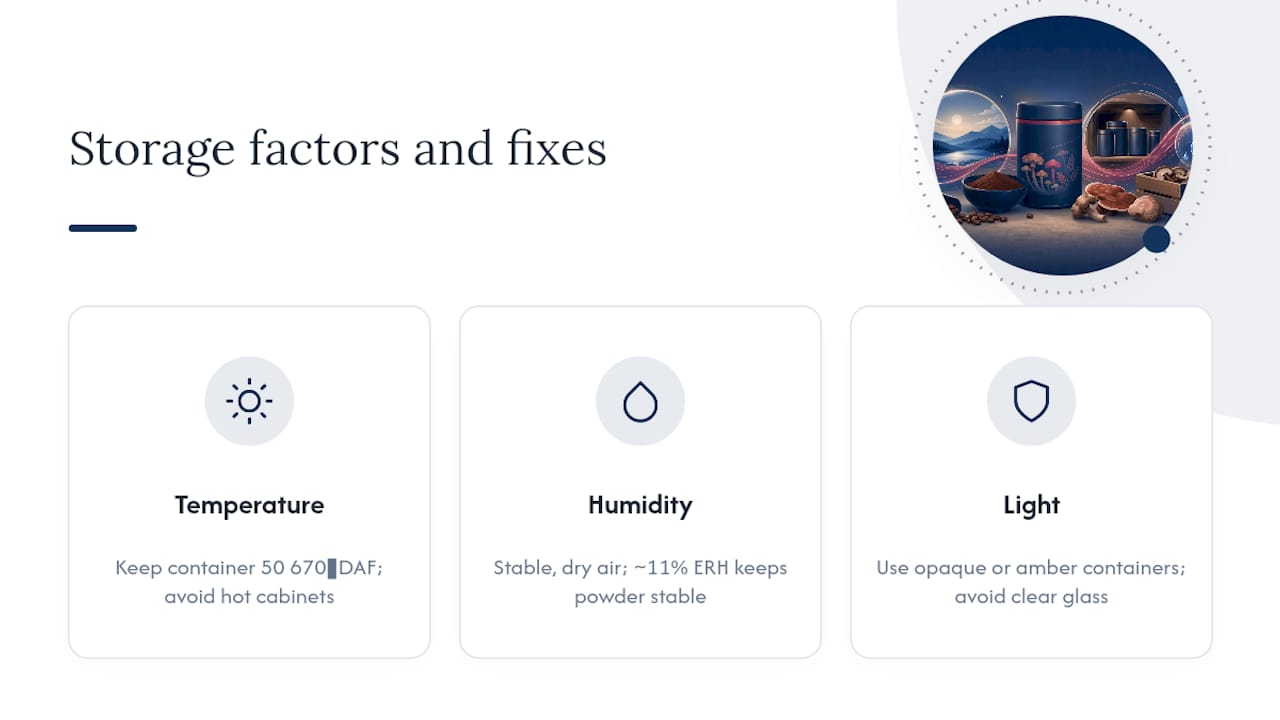
Instant mushroom coffee behaves a lot like instant regular coffee: it’s a dry, soluble powder that reacts fast to its environment. Heat speeds up the breakdown of delicate compounds like the beta-glucans in Reishi and Turkey Tail, so keeping the container between 50 and 70°F slows that clock down. A hot cabinet above the stove, or a sunny counter in summer, pushes the powder toward the warm end of that range far more often than most people realize.
Humidity is the bigger threat, and research on instant coffee gives us real numbers to work from. A study on environmental humidity and instant coffee stability found that powder held at roughly 11% environmental relative humidity (ERH) stayed stable for the long haul.
Your pantry doesn’t have a humidity gauge on the wall, but the takeaway translates directly: the drier and more stable the air around your container, the longer the powder holds its potency. A bathroom cabinet or a spot near the kettle is the wrong call.
Light is the third factor, and it’s the one people forget. UV and even regular visible light accelerate the degradation of light-sensitive compounds in mushroom extracts, which is why an opaque or amber container beats a clear glass jar on a sunny shelf every time.
Should You Use the Original Pouch or Decant It?
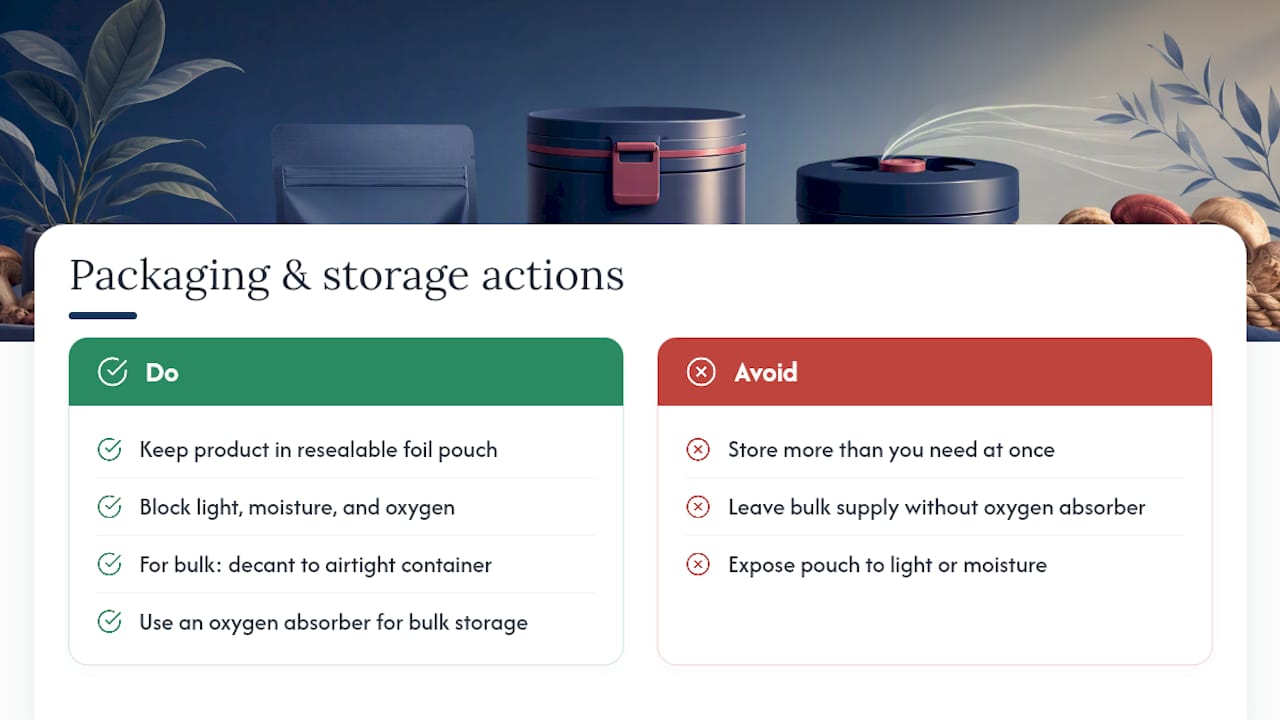
For most buyers, the factory pouch is genuinely enough. Flexible foil pouches use multilayer construction, often combining aluminum foil with polyethylene, and that combination gives you an excellent barrier against water vapor and oxygen when the seal is intact. If you’re working through a bag in one to three months, reseal it tightly after each use and you’re covered.
Bulk buyers and slow sippers need a different plan. Once you’re looking at four months or more before the bag empties, decanting protects you from the cumulative effect of repeated opening.
Good long-term containers share three traits: opaque or amber glass (violet Miron glass works well too), a genuinely airtight gasket or clamp lid, and a size that roughly matches how much powder you’re storing so there’s little empty air space above the powder line. Food-grade stainless steel canisters with rubber-sealed lids are another solid option.
- Amber or Miron glass jars with a rubber-gasket clamp lid for pantry storage.
- Heat-sealed Mylar bags for buyers who purchase in true bulk, ideally paired with an oxygen absorber.
- Food-grade stainless steel canisters for anyone who wants a break-proof option near the stove area.
- Whatever you choose, downsize the container as the powder level drops rather than leaving a half-empty jar with too much air inside.
How Do Desiccants and Oxygen Absorbers Actually Work?
These two tools solve different problems, and mixing them up wastes money.
- Desiccants pull moisture out of the air inside the container. They’re most useful if you live somewhere humid or you’ve noticed your powder feels slightly damp to the touch.
- Oxygen absorbers remove oxygen, not water. They slow oxidation, which is what dulls flavor and degrades certain mushroom compounds over months of storage. They only work inside a container that seals hermetically, like a heat-sealed Mylar bag or a jar with a true gasket.
- Vacuum sealing helps, but only on fully dry powder. If there’s any residual moisture, pulling a vacuum can actually draw that moisture toward the surface instead of locking it away.
For serious bulk storage, using a desiccant and an oxygen absorber together gives you broader protection than either tool alone, since one handles water and the other handles air.
Pro Tip: Oxygen absorbers activate the moment you open their individual packet, so add yours right before you seal the container, not five minutes earlier while you’re still organizing your pantry.
What Are the Warning Signs of Bad Storage?
Your eyes and nose will usually catch a problem before any lab test would matter to you. Clumping is the first tell. Instant powder should pour and dissolve freely; if it’s forming lumps or sticking to the sides of the container, moisture has already gotten in.
- Clumping or caking that wasn’t there when you opened the bag.
- Powder that won’t fully dissolve in hot water or leaves visible grit at the bottom of the cup.
- A musty, stale, or sour smell instead of the usual roasted coffee aroma.
- Any visible mold, discoloration, or fuzzy spots. Discard immediately if you see this.
Packaging research on instant coffee ties visible quality loss to moisture content climbing to roughly 10 to 12%, well above the level found in a properly sealed, fresh product. Clumping and solubility problems tend to show up before the powder has degraded enough to worry about nutritionally, which makes them a genuinely useful early warning rather than a false alarm. If you’re staring at a jar and asking whether it’s still good, that hesitation is itself the answer: toss it.
Daily Use and Travel Without Wrecking the Main Batch
Every time you open your main container, you’re rolling the dice on humidity. Cut that risk by keeping a small opaque jar on the counter for daily scoops, refilled from the sealed main supply every week or two instead of opened three times a day.
- Fill a small stainless or amber jar for daily portions and leave the main container sealed most of the time.
- For trips, pack a compact canister inside a padded pouch, or grab single-serve sachets if you travel often.
- Write the fill date on a strip of tape on any travel container so you’re not guessing later.
How Emberk Packages for Freshness
The blends are shipped in multi-layer, resealable foil pouches designed for daily and short-term use, blocking light, moisture, and oxygen as the barrier research above describes. For anyone buying in bulk, we recommend the same decanting approach covered in this guide: an airtight container and an oxygen absorber once you’re looking at a supply that will outlast a few months.
That care traces back to why the product exists in the first place. Every batch uses sustainably sourced mushrooms across all six functional varieties, with no fillers diluting the active compounds you’re trying to preserve. Choosing a bag size that matches your drinking pace, or setting up a subscription so you are never storing more than you need, can help protect potency.
A Realistic Take on Storage Habits
Most people finish a bag in one to three months, and for that group, careful resealing after every scoop is genuinely enough. Nothing fancy required.
Bulk buyers are a different story. Decanting into a real airtight container and adding an oxygen absorber takes maybe five minutes total, and it’s the difference between a jar that tastes right on day 90 and one that doesn’t. A monthly glance for clumping or off smells removes the guesswork, so you’re never wondering, just checking.
— Emberk
Choosing the Right Size to Skip Long-Term Storage
The easiest way to avoid the whole decanting problem is buying a bag you’ll actually finish in one to three months. Resealable foil pouches are designed to hold flavor and potency through normal daily use without extra containers or tools.
If your household drinks more, or you’re stocking up ahead of a busy season, grab a larger size from the mushroom coffee product page or the mushroom latte line and plan to decant it using the methods above. Browse the full product collection to match a size to your actual drinking pace, or set up a subscription so fresh bags arrive before your current one runs low. That single choice does more for freshness than any container upgrade ever will.
Sources
This guide draws on instant coffee humidity research, packaging barrier studies, and a practical mushroom powder storage guide, alongside independent coverage from The Functional Sip.
- Impact of Environmental Humidity on Instant Coffee Stability: Defining Moisture Thresholds for Quality Degradation and Shelf Life Prediction
- Instant coffee: Products and packaging systems characteristics
- Keep Your Mushroom Powder Potent: Long-Term Storage Secrets – Non Fungible Mushrooms
FAQ
Is Mushroom Coffee Perishable?
It doesn’t spoil the way fresh food does, but it degrades. Moisture and oxygen exposure gradually reduce potency and flavor, and visible clumping or mold means it’s time to discard it.
What Is the Shelf Life of Mushroom Coffee Once Opened?
Most sealed pouches, resealed properly after each use, stay fresh for one to three months. Decanting into an airtight container with an oxygen absorber extends that window considerably.
Can I Store Mushroom Coffee in the Fridge or Freezer?
No. Cold storage introduces condensation every time you open the container, and that moisture is exactly what causes clumping and quality loss in a hygroscopic powder.
Does Instant Coffee Go Bad the Same Way as Mushroom Coffee?
Both are dry, soluble powders that respond to humidity in similar ways, and the same research on ERH thresholds applies to both. Stable storage conditions matter more than an expiration date printed on the bag.
What’s the Best Storage for Mushroom Coffee if I Buy in Bulk?
An opaque, airtight container like amber glass or a heat-sealed Mylar bag with an oxygen absorber, kept between 50 and 70°F away from light, gives bulk supplies the best chance at holding potency for months.
0 comments