

Most people who try lion’s mane tolerate it well, but mild digestive symptoms like nausea, bloating, and diarrhea show up in a small share of users, and occasional skin irritation gets reported too. Rare, isolated cases of severe allergic reactions, including respiratory distress, have appeared in the medical literature. If you develop trouble breathing, swelling, or hives, stop taking it and seek urgent care immediately; for milder, lingering symptoms, check in with a clinician.
TL;DR:
- Most users tolerate lion’s mane well, but mild digestive symptoms such as nausea, bloating, and diarrhea are reported in some cases, particularly during initial use.
- Serious allergic reactions, including respiratory distress, are rare but documented, requiring immediate medical attention if symptoms like trouble breathing or swelling occur.
- People with mushroom allergies, pregnant or breastfeeding women, and those with immune or chronic conditions should consult a healthcare professional before trying lion’s mane.
- There are no large-scale studies on long-term daily use, but short-term trials suggest doses around 1 to 3 grams are generally safe if monitored.
- Product quality, especially choosing formulations with fruiting body mushrooms and transparent ingredient lists, significantly influences tolerability and safety.
Table of Contents
- Common Mild Side Effects Reported In Studies
- When Reactions Turn Serious (And What The Case Reports Show)
- Who Should Talk To A Doctor Before Trying Lion’s Mane
- What We Know (And Don’t) About Lion’s Mane Interactions
- Is Daily Lion’s Mane Use Safe?
- Cutting Your Risk: What To Look For In A Product
- Reporting Side Effects And Handling An Emergency
- Where Emberk Fits In The Safety Conversation
- Our Take: Safety Comes From Habits, Not Hype
- Try Lion’s Mane The Way Emberk Built It: Clean And Lab-Tested
- Sources
- FAQ
Common Mild Side Effects Reported In Studies
Think of your gut as the first checkpoint any new supplement has to pass through, and lion’s mane is no exception. The systematic review covering Hericium erinaceus as a supplement found the most frequently reported reactions cluster around the digestive system, with skin and neurological complaints trailing behind.
The pattern that emerges across small clinical trials looks like this:
- Nausea and stomach discomfort, often mild and short-lived
- Bloating and abdominal cramping
- Diarrhea, typically resolving without treatment
- Mild headaches
- Skin rashes or localized irritation
Statistic callout: The LiverTox overview from NCBI reports that mild gastrointestinal complaints appeared in a minority of participants across the small clinical trials it summarizes. That is a low bar, but it is also based on modest sample sizes and short trial windows, so it tells you more about what to watch for than exactly how often it happens to the average person.
Here is the honest caveat worth sitting with: most of the trials behind these numbers ran for weeks, not years, and involved dozens of participants rather than thousands. That is standard for a supplement still building its evidence base, but it also means the true rate of mild side effects in the general population remains fuzzy. If you notice stomach upset after starting lion’s mane, you are not an outlier. You are, statistically, part of a recognized minority.
When Reactions Turn Serious (And What The Case Reports Show)
Severe reactions to lion’s mane are rare, but they are documented, and they deserve a straight answer rather than a shrug. The same systematic review that catalogs stomach upset and headaches also describes isolated case reports of acute respiratory distress linked to Hericium erinaceus use, alongside other allergic reactions.
A case report is not the same thing as a clinical trial. It describes one person’s experience, carefully documented by clinicians, but it cannot tell you how many people out of a thousand would react the same way. What it does tell you is that the possibility exists, and that your body’s immune system treats mushroom proteins the way it treats any other potential allergen, sometimes with an outsized response.
Watch for these signs, and treat any of them as a reason to stop use and get emergency help right away:
- Difficulty breathing or a tight feeling in the chest
- Swelling of the face, lips, tongue, or throat
- Widespread hives or a rapidly spreading rash
- Fainting or feeling like you might pass out
The LiverTox summary notes at least one acute hypersensitivity case in its review of the evidence, reinforcing that these events, while uncommon, are not theoretical. The evidence base here leans heavily on small trials and spontaneous safety reports rather than large-scale surveillance, so caution beats confidence when it comes to predicting your own risk.
Who Should Talk To A Doctor Before Trying Lion’s Mane
Lion’s mane is not a fit for every situation, and a few groups should treat “should I try this” as a question for a clinician, not a search engine.
- Anyone with a known mushroom allergy or a history of allergic reactions to fungi. Cross-reactivity is a real concern, and a prior reaction is the clearest warning sign you have.
- People who are pregnant or breastfeeding. Human safety data for this population is thin, and the LiverTox overview points out that most safety conclusions come from small trials that did not include pregnant or nursing participants.
- People managing severe asthma, autoimmune disease, or another serious chronic condition. Immune-related conditions add a layer of unpredictability to how your body might respond to a mushroom-derived compound.
- Anyone on multiple prescription medications, especially immunosuppressants or blood thinners. The more moving parts in your regimen, the more value a pharmacist’s second opinion adds before you introduce something new.
None of this means lion’s mane is dangerous for these groups by default. It means the safety data simply has not caught up to the questions these situations raise, and a five-minute conversation with a clinician is cheap insurance against an unknown.
What We Know (And Don’t) About Lion’s Mane Interactions
Here is the blunt truth: there are no robust human interaction studies for lion’s mane and prescription medications. That gap matters more for some people than others. Researchers have flagged theoretical concerns around immune-modulating effects and, separately, around anticoagulation, since some fungal compounds influence platelet activity in lab settings. Neither concern has been confirmed in real-world clinical data, but “unconfirmed” cuts both ways. It is not proof of harm, and it is not proof of safety either.
The practical response is straightforward:
- Talk to a pharmacist or clinician before combining lion’s mane with prescription drugs, particularly blood thinners or immune-modulating medications.
- Avoid starting several new supplements at once. If something goes wrong, you want to know which one caused it.
- Keep a running list of everything you take, and share it at your next appointment.
Pro Tip: Keep a simple daily log for the first two weeks: what you took, what time, and any symptoms that follow. It takes thirty seconds and turns a vague “something feels off” into a pattern you and your doctor can actually work with.
Is Daily Lion’s Mane Use Safe?
Small trials give a cautiously reassuring answer. Daily doses ranged from around 1 gram up to several grams of powdered fruiting body, with some studies using erinacine-enriched extracts at more concentrated levels. These regimens generally ran without major toxicity showing up.
Statistic callout: One line of research the LiverTox review cites used daily doses in a low-gram range for several weeks without triggering serious adverse events, though the trial size and duration were both limited.
So is daily use “bad”? Short-term evidence says no, but “short-term” is doing real work in that sentence. Long-term daily use over months or years has not been studied at scale, which is different from being unsafe. If you decide to try it daily, start low, give it one to four weeks, and stop right away if anything feels off.
- Begin with the lowest labeled dose rather than the high end of any range
- Track how you feel for at least two to four weeks before increasing
- Discontinue and reassess if digestive symptoms or skin reactions persist
Cutting Your Risk: What To Look For In A Product
A lot of the variation in how people react to lion’s mane traces back to what is actually in the product, not the mushroom species itself. Formulations built on 100% fruiting body with a clearly stated extraction method tend to behave more predictably than opaque blends where you cannot tell if you are getting mostly mycelium grown on grain. Practitioners commonly point to mycelium-on-grain products as more likely to carry starchy fillers, which can contribute to the bloating and digestive discomfort some users report.
A few habits lower your odds of an unpleasant surprise:
- Choose products that clearly state fruiting body content, extraction method, and third-party lab testing.
- Introduce one new mushroom product at a time so you can actually isolate what caused a reaction, if one shows up.
- Check the full ingredient list for fillers, added herbs, or caffeine that might explain a reaction better than the lion’s mane itself.
- Note whether you are trying it as a coffee blend, capsule, or raw powder, since formulation changes how quickly compounds hit your system.
Our guide on lion’s mane and coffee walks through how format affects tolerability in more detail, and The Functional Sip’s roundup of mushroom supplements is a useful read for seeing how extraction differences show up across commercial products.
Reporting Side Effects And Handling An Emergency
If you experience breathing problems, facial or throat swelling, fainting, or severe vomiting after taking lion’s mane, treat it as an emergency and get medical attention immediately, not “later today.”
For non-emergency reactions worth flagging, Canadians can report adverse effects through Health Canada’s MedEffect program, either online or by phone at 1-866-234-2345. Reporting matters beyond your own case. It feeds the signal-detection system that helps regulators catch patterns before they become widespread problems.
Where Emberk Fits In The Safety Conversation
Product quality is one of the few variables you actually control when trying a new mushroom supplement, which is why sourcing decisions carry real weight. Emberk builds every blend from 100% fruiting body mushrooms, tests them in a lab, and skips the fillers that muddy formulation quality elsewhere in the category. That is a quality signal, not a medical guarantee, and it does not override anything covered above about allergy risk or clinician consultations.
The same monitoring habits apply here as anywhere: start with a low amount, try single-ingredient products before stacking several functional mushrooms together, and log how you feel. Our guide to what lion’s mane actually is and our mushroom coffee FAQ both walk through practical ways to isolate variables when you are testing a new blend.
Our Take: Safety Comes From Habits, Not Hype
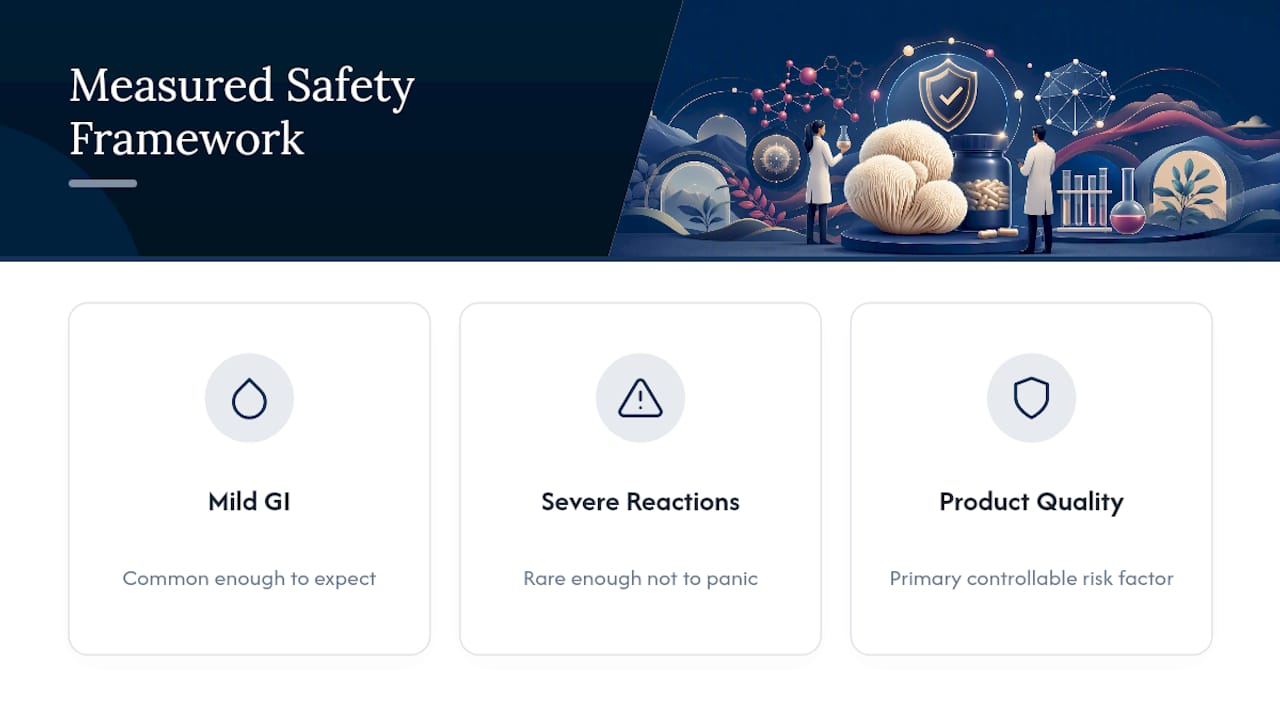
The conventional wisdom on lion’s mane side effects tends to swing between two extremes: dismissing them entirely because “it’s natural,” or treating every case report like a red alert. Neither serves you well. The evidence, thin as it is, supports a measured middle ground: mild GI symptoms are common enough to expect, severe reactions are rare enough not to panic over, and the real risk factor most people overlook is product quality, not the mushroom itself.
What gets underrated in most coverage of this topic is how much control you actually have. You cannot change the state of the clinical research, but you can choose a fruiting-body product over a filler-heavy one, introduce it alone instead of stacking five new supplements at once, and pay attention for two weeks instead of assuming silence means safety. That is not a workaround for weak evidence. It is the correct response to it.
If there is one habit worth adopting before anything else, it is the symptom log. It turns a vague sense that “something feels off” into information you and a clinician can actually use.
— Emberk
Try Lion’s Mane The Way Emberk Built It: Clean And Lab-Tested
If everything above has you leaning toward trying lion’s mane but wanting fewer unknowns in the formula, that is exactly the gap Emberk was built to close. Emberk’s mushroom coffee blends lion’s mane with five other adaptogens, all sourced as 100% fruiting body and lab-tested before it reaches your cup, so you are not guessing what is filling out the ingredient list.

Starting with one cup a day and paying attention to how you feel is a reasonable way to trial it, following the same low-and-slow approach covered earlier. If you have a chronic condition, take prescription medication, or are pregnant or breastfeeding, talk to your clinician first regardless of which product you choose. Ready to see what a cleaner formulation feels like? Check out the current mushroom coffee lineup and start with a single bag before committing to a subscription.
This article is general information, not a substitute for advice from a qualified doctor. Consult a qualified healthcare professional about your own circumstances before acting on anything here.
Sources
- Benefits, side effects, and uses of Hericium erinaceus as a supplement: a systematic review
- Lion’s mane - LiverTox - NCBI Bookshelf
- MedEffect Canada — reporting adverse reactions
FAQ
What Are The Risks Of Taking Lion’s Mane?
The main risks are mild digestive upset (nausea, bloating, diarrhea) and, rarely, allergic reactions ranging from skin rash to severe respiratory distress in isolated case reports documented in the systematic review.
What Should You Not Mix With Lion’s Mane?
Avoid combining it with new supplements or medications, especially blood thinners or immunosuppressants, without checking with a pharmacist first, since human interaction data for lion’s mane remains limited.
Is It Bad To Take Lion’s Mane Every Day?
Small trials using daily doses of roughly 1 to 3 grams over several weeks did not show major toxicity, but long-term daily use has not been studied at scale, so starting low and monitoring for a few weeks is the safer approach.
Why Do I Feel Weird After Taking Lion’s Mane?
Unusual sensations after starting lion’s mane are usually mild and tied to digestive adjustment or formulation quality, but if you experience breathing trouble, swelling, or hives, stop immediately and seek emergency care.
Is Mushroom Coffee Safe Alongside Lion’s Mane?
Mushroom coffee that clearly lists fruiting-body content and lab testing, like Emberk’s blends, follows the same safety principles as standalone lion’s mane: start with a small amount and watch for reactions over the first couple of weeks.
0 comments