

Coffee reliably improves short-term alertness and task performance when you follow three simple rules: wait about one hour after waking before your first cup, stay within a moderate range of caffeine per day, typically considered a few cups of brewed coffee, and stop drinking by mid to late afternoon to protect your sleep. That’s the bottom line. Everything below explains why those rules work and how to build them into a routine you can test today.
Three rules to try right now:
- Wait one hour after waking. Your cortisol is naturally elevated in the first 30–60 minutes after you wake up. Adding caffeine on top of that spike can deepen the subsequent crash. Let cortisol settle first, then drink.
- Stay in the 200–400 mg range. That’s roughly 2–4 eight-ounce cups of brewed coffee. Harvard’s Nutrition Source notes that moderate intake around this range is associated with health benefits and is the most widely cited safety reference.
- Stop by 2:00–3:00 PM. Caffeine has a half-life of roughly 5–6 hours in most adults, meaning an afternoon cup can still be active in your system at midnight.
A quick note on who should limit caffeine: If you’re pregnant, the general guidance is to stay at or below 200 mg per day. People with uncontrolled hypertension, certain cardiac arrhythmias, or anxiety disorders should consult a clinician before using caffeine as a productivity tool. When in doubt, check with your doctor first.
Key Takeaways
Used with the right timing and dose, coffee is one of the most evidence-backed tools available for short-term focus and alertness.
| Point | Details |
|---|---|
| Wait one hour after waking | Letting cortisol settle before your first cup reduces the spike-and-crash pattern. |
| Stay within 200–400 mg daily | Roughly 2–4 cups of brewed coffee; above 400 mg, side effects become more likely. |
| Stop caffeine by 2:00–3:00 PM | Caffeine’s 5–6 hour half-life means afternoon cups can disrupt sleep even when you feel fine. |
| Pair caffeine with a task and a meal | Drinking coffee before focused work and alongside food produces steadier, longer-lasting effects. |
| Emberk for lower-jitter focus | Emberk’s mushroom coffee delivers moderate caffeine plus Lion’s Mane adaptogens for calm, sustained alertness. |
Table of Contents
- How caffeine actually works in your brain
- What the research actually shows about short-term gains vs. long-term productivity
- How much to drink and when: dosing, timing, and the coffee nap
- Practical routines that actually pair coffee with focused work
- Side effects, who should limit intake, and how to taper safely
- Emberk’s mushroom coffee fits neatly into these routines
- What we actually think about coffee and productivity
- Steadier energy, less jitter: try Emberk’s mushroom coffee
- Sources
- FAQ
How caffeine actually works in your brain
Caffeine is a stimulant, but it works less like a gas pedal and more like a blocker. Think of adenosine as your brain’s natural “slow down” signal. Throughout the day, adenosine molecules accumulate and bind to receptors, making you feel progressively sleepier. Caffeine fits into those same receptors without activating them, essentially parking in the spot so adenosine can’t dock. The result is that your brain keeps firing at a higher rate than it otherwise would.
That’s only part of the picture. By blocking adenosine, caffeine indirectly allows dopamine and norepinephrine to circulate more freely, which is why you feel not just awake but motivated and alert. A controlled EEG study published in Scientific Reports found that coffee reorganized brain functional connectivity toward more efficient network properties, with measurable improvements in executive function tests appearing about 30 minutes after consumption.
The timeline you can expect:
- Onset: 15–45 minutes after drinking
- Peak effects: roughly 30–120 minutes in
- Half-life: 5–6 hours on average, though genetics, liver function, and medications can push this anywhere from 3 to 9 hours
- Cortisol interaction: cortisol peaks naturally in the first hour after waking; caffeine on top of that spike can amplify the crash that follows
Experts interviewed by WIRED recommend waiting about one hour after waking before your first cup, and many advise stopping by around 3:00 PM to protect sleep quality. Your chronotype may influence the optimal timing of your first coffee, with some people having later natural alertness peaks.
What the research actually shows about short-term gains vs. long-term productivity
The evidence for caffeine is strong in some areas and genuinely thin in others. Here’s an honest look at both.
Where the evidence is solid:
A randomized, blind, crossover study found that low-dose caffeine taken roughly 60 minutes before a lecture significantly increased self-reported wakefulness, energy, and concentration in student participants compared to placebo. A separate Frontiers in Psychology study showed that caffeine can improve explicit memory during a person’s non-optimal time of day, such as early morning for young adults, while the same benefit may not appear during peak alertness hours. The EEG study mentioned above adds a mechanistic layer: improved performance on executive tasks like the Trail Making Test correlated with measurable changes in brain network efficiency.
A review of caffeine and cognition confirms reliable acute benefits for attention, reaction time, and some executive functions, but notes that effects on creative tasks and long-term productivity output are far less consistent.
Where the evidence gets complicated:
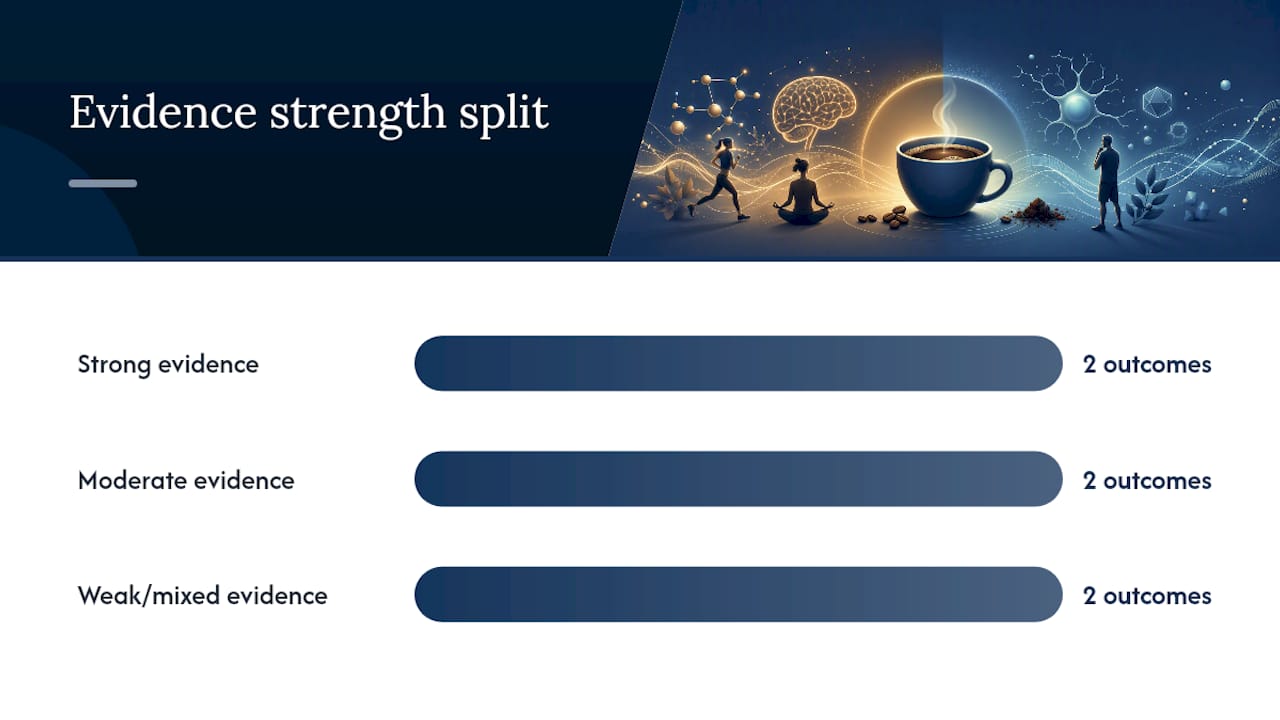
| Outcome | Evidence strength | Key caveat |
|---|---|---|
| Short-term alertness | Strong | Dose-dependent; requires adequate intake |
| Reaction time | Strong | Most consistent across study designs |
| Executive function | Moderate | Best at non-optimal times of day |
| Explicit memory | Moderate | Time-of-day dependent |
| Creative output | Weak/mixed | Less consistent across studies |
| Long-term productivity | Weak | Tolerance, sleep debt, and habits confound results |
A cross-sectional study of office workers found no significant alertness difference between coffee drinkers and non-drinkers when average daily caffeine intake in the sample was only about 72 mg per day. That’s a meaningful signal: the dose has to be sufficient to produce measurable effects. Sipping a weak half-cup isn’t the same as a properly dosed serving.
The practical takeaway is this: expect reliable short-term improvements in attention and certain cognitive tasks, particularly during your low-alertness windows. Don’t expect caffeine alone to compensate for poor sleep, chronic stress, or an unstructured workday.
How much to drink and when: dosing, timing, and the coffee nap
Getting the dose and timing right is where most people leave performance on the table.
Caffeine by the numbers:
The Harvard Nutrition Source places the commonly cited safe daily maximum at around 400 mg for healthy adults, roughly 3–5 cups of brewed coffee. During pregnancy, the general recommendation drops to 200 mg or less per day. Low-to-moderate doses in the 50–300 mg range tend to improve alertness and concentration; doses above that increase the risk of anxiety, restlessness, and elevated heart rate.
Your timing cheatsheet:
- Wait ~1 hour after waking before your first cup. This lets your natural cortisol peak pass so caffeine adds to your alertness rather than compounding a spike you’ll crash from later.
- Schedule your main dose 30–60 minutes before focused work. Onset takes 15–45 minutes, so plan ahead.
- Use a second cup strategically, around late morning or early afternoon, rather than reflexively.
- Stop by 2:00–3:00 PM if you’re sensitive to caffeine. Some people with fast caffeine metabolism can push to 3:00 PM; if you struggle to fall asleep, move the cutoff to noon.
For a deeper look at how caffeine’s half-life interacts with sleep, this guide on caffeine duration is worth bookmarking.
The coffee nap: a surprisingly effective trick
A coffee nap works like this: drink a small, quick coffee (one shot of espresso or a small brewed cup), then immediately lie down and rest for 15–20 minutes. Caffeine takes about 20–30 minutes to reach peak absorption, so by the time it kicks in, your brief rest has already cleared some adenosine from your receptors. The result is a compounding effect: you wake from the nap feeling refreshed, and the caffeine amplifies that. Set an alarm so you don’t sleep past 20 minutes and enter deeper sleep stages, which would leave you groggy instead.
Practical routines that actually pair coffee with focused work
Caffeine is a tool, not a strategy. The research on coffee rituals and productivity consistently shows that pairing caffeine with a clear task intention produces better outcomes than drinking coffee and then deciding what to do.
1. The morning focus block Drink your first cup about an hour after waking, then immediately move into your most cognitively demanding work. This is the window where caffeine’s effects on attention and executive function are most reliable, especially if you’re a morning person working during your non-optimal alertness period.
2. The pre-meeting boost A single espresso 30–45 minutes before a meeting that requires sharp verbal reasoning or quick recall is well-supported by the reaction-time and executive-function evidence. Keep the dose modest: one shot rather than a large cold brew.
3. The afternoon maintenance dose If you need a second dose, time it before 2:00 PM and pair it with a short walk or a change of environment. This acts as a natural microbreak that resets attention on its own, so the caffeine is supporting a reset rather than masking fatigue.
Hydration and meal pairing matter more than most people realize. Caffeine is a mild diuretic, and even mild dehydration measurably impairs concentration. Drink a glass of water alongside your coffee. Pairing caffeine with a protein-containing meal or snack slows absorption and blunts the sharp spike-and-crash pattern that comes from drinking on an empty stomach.
Pro Tip: Combining 100–200 mg of caffeine with 100–200 mg of L-theanine, an amino acid found naturally in green tea, tends to smooth out jitteriness while preserving the alertness benefit. The combination has been studied for its effects on attention and is one of the most commonly cited pairings in the nootropics literature. If you’re sensitive to caffeine’s anxious edge, this is worth trying before you give up on caffeine entirely.
The ritual of preparing coffee also carries a real, if underappreciated, benefit. A deliberate brewing pause, whether you’re using a pour-over or simply waiting for a kettle, functions as a microbreak that resets attention before you sit back down to work. That brief pause is part of why many people report feeling more focused after making coffee, not just from drinking it.

Side effects, who should limit intake, and how to taper safely
Caffeine is one of the most studied substances in the world, and its risk profile at moderate doses is well-established. That doesn’t mean it’s right for everyone.
Common side effects at higher doses:
- Anxiety and restlessness (especially above 300–400 mg)
- Insomnia or disrupted sleep architecture, even when you feel like you fall asleep fine
- Heart palpitations or elevated heart rate
- GI upset, particularly on an empty stomach
- Headaches during withdrawal
Groups who should limit or avoid caffeine:
- Pregnant people: stay at or below 200 mg per day based on widely cited guidance
- People with uncontrolled hypertension or certain cardiac arrhythmias: caffeine raises blood pressure acutely; consult a clinician
- People with anxiety disorders: caffeine can amplify anxiety symptoms, sometimes significantly
- Adolescents: developing nervous systems are more sensitive; lower thresholds apply
Dose-dependent effects are real. Low-to-moderate doses (roughly 50–300 mg) tend to improve alertness and concentration. Above that range, the risk of anxiety, restlessness, and elevated heart rate increases meaningfully, according to Harvard’s Nutrition Source.
How to taper if you want to cut back: Reduce your daily intake by about 25 mg every few days rather than stopping abruptly. Withdrawal symptoms, primarily headaches and fatigue, typically peak at 20–51 hours after the last dose and resolve within a week for most people. If you’re experiencing significant symptoms, a clinician can help you manage the process.
This article provides general information, not medical advice. If you have a health condition affected by caffeine, confirm current guidance with your doctor or a qualified healthcare provider.
Emberk’s mushroom coffee fits neatly into these routines
If you’ve read this far, you know that the sweet spot for focus coffee is a moderate, well-timed dose that doesn’t spike anxiety or crash your afternoon. That’s exactly the design logic behind Emberk’s mushroom coffee: instant organic coffee blended with six functional mushrooms, including Lion’s Mane, Chaga, Reishi, Turkey Tail, Maitake, and Cordyceps, with no fillers, no added sugars, and no artificial ingredients.
The lower caffeine content per serving (compared to a large cold brew or a double espresso) makes it easier to stay within the 200–400 mg daily window without careful measuring. Lion’s Mane, one of the most studied functional mushrooms for cognitive support, is included at meaningful levels from 100% fruiting body sources, not mycelium powder. For a deeper look at how these adaptogens work alongside caffeine, the nootropics and adaptogens overview on Emberk’s site is a useful read.
How to fold Emberk into the routines above:
- Use it as your first cup, about an hour after waking, when you want stable alertness without the cortisol-spike risk of a strong black coffee
- Pair it with a protein-containing breakfast to slow absorption and extend the energy curve
- If you’re sensitive to caffeine, the mushroom latte option offers an even lower-caffeine alternative with a creamy texture
- Check the ingredient list if you have known sensitivities to any of the six mushroom species
One thing worth noting: Emberk’s products are dairy-free and made without artificial ingredients, which matters if you’re pairing your morning coffee with a clean-eating routine. The subscription option also removes the friction of reordering, which is a small but real benefit when you’re trying to build a consistent morning habit.
What we actually think about coffee and productivity
The most honest thing we can say about using coffee for productivity is this: the evidence is real, but it’s narrower than the marketing around caffeine usually suggests.
Caffeine reliably sharpens attention and speeds reaction time, especially during your low-alertness windows. That’s genuinely useful. What it doesn’t do is substitute for sleep, fix a chaotic schedule, or make creative breakthroughs happen on demand. The review literature is clear that effects on complex creative tasks are inconsistent, and tolerance builds faster than most people expect, which is why the timing and dose discipline in this article matters more than the specific product you choose.
What we find more interesting than the pharmacology is the ritual layer. The act of making coffee, the pause, the sensory cue, the intention-setting before you sit down to work, adds a psychological benefit that pure caffeine supplementation doesn’t replicate. That’s part of why we think a thoughtfully designed product like Emberk, where the preparation ritual is preserved even in an instant format, is worth considering over a caffeine pill or an energy drink. The experience is part of the benefit.
The best approach is to treat your caffeine intake as a small, trackable experiment. Start with the one-hour wait rule, note how your focus holds through the morning, and adjust from there. Small, honest experiments beat rigid protocols every time.
Steadier energy, less jitter: try Emberk’s mushroom coffee
Most productivity coffees ask you to choose between strong caffeine and calm focus. Emberk’s mushroom coffee blend gives you both: organic coffee paired with six functional mushrooms, including Lion’s Mane for cognitive support, at a caffeine level designed to keep you in the sweet spot the research actually supports.

No fillers, no artificial ingredients, and no afternoon crash spiral. It fits directly into the timing and dose framework in this article: one serving in the morning, about an hour after waking, paired with breakfast. Try a single serving or start a subscription through Emberk’s full product collection and see how it fits your routine.
Sources
These are the sources we drew on most heavily. Each one is worth reading if you want to go deeper on a specific claim.
- The Best Time to Drink Coffee for Productivity (and When Not To) | WIRED
- Coffee • The Nutrition Source
- PubMed record (caffeine supplement study)
- Coffee consumption and alertness: a study among office workers (PMC)
- Drinking coffee enhances neurocognitive function by reorganizing brain functional connectivity | Scientific Reports
- Caffeine and time-of-day effects on memory (Frontiers in Psychology)
- Ncbi
This article is general information, not a substitute for advice from a qualified doctor. Consult a qualified healthcare professional about your own circumstances before acting on anything here.
FAQ
Should I drink coffee for productivity?
Yes, with caveats. Coffee reliably improves short-term alertness, reaction time, and attention, particularly during your low-energy windows, but it works best when timed correctly (about one hour after waking) and kept within a moderate daily dose of 200–400 mg.
What is the 2-hour coffee rule?
The “2-hour rule” most commonly refers to waiting at least two hours after waking before your first cup, a more conservative version of the one-hour guideline. The underlying logic is the same: letting your natural cortisol peak pass before adding caffeine reduces the risk of a sharper energy crash later in the day.
What is the 15-15-15 coffee rule?
The 15-15-15 rule isn’t a standardized protocol in the research literature, and definitions vary. A common version describes a morning rhythm of 15 minutes of light activity, 15 minutes of preparation or planning, and 15 minutes before drinking coffee, essentially a structured delay that lets cortisol settle before caffeine enters the picture.
Which coffee is best for productivity?
The best focus coffee is one that delivers a moderate, consistent caffeine dose without triggering anxiety or a hard crash. Brewed coffee at around 95 mg per 8-ounce cup is a reliable baseline. For people sensitive to jitters, a lower-caffeine option like Emberk’s mushroom coffee blend, which pairs organic coffee with Lion’s Mane and other adaptogens, is worth considering for steadier, calmer energy.
How do I avoid the afternoon caffeine crash?
Keep your total daily intake within 200–400 mg, stop drinking caffeine by 2:00–3:00 PM, and pair your coffee with food rather than drinking it on an empty stomach. A coffee nap (a 15–20 minute rest immediately after a small espresso) can also help you get through an afternoon slump without a late caffeine dose that disrupts sleep.
0 comments